“Expand Chungcheong Region’s Transport Network, Relocate 50 Public Institutions”...Park Soo-hyun, South Chungcheong Governor, Asks Government
- Input
- 2026-11-16 17:00:00
- Updated
- 2026-11-16 17:00:01
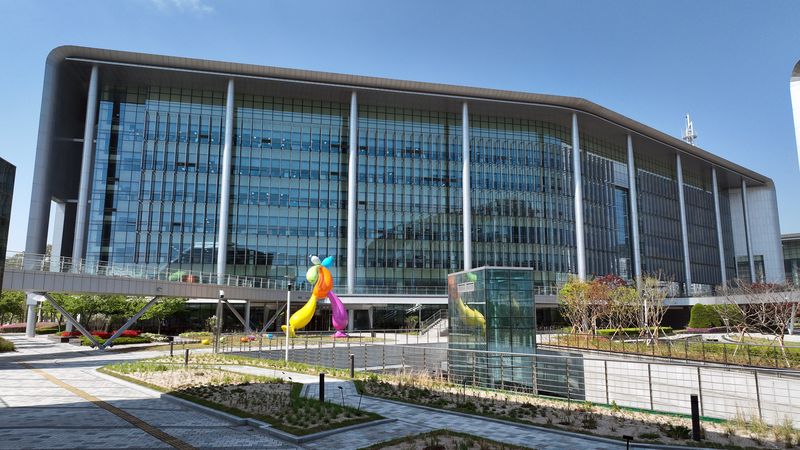
On the 16th, Park visited the Ministry of Land, Infrastructure and Transport and met with Minister Hong Ji-seon. In his capacity as chair of the Chungcheong Metropolitan Union and governor of South Chungcheong Province, he formally proposed five key tasks for the joint development of the Chungcheong region and balanced regional development.
Calls for Chungcheong Region Road and Rail Projects to Be Included in National Plans
First, in his capacity as chair of the Chungcheong Metropolitan Union, Park called for the inclusion of super-regional road and rail projects in the Chungcheong region in national plans and for national funding to cover operating costs for the Sejong-Gongju Bus Rapid Transit (BRT) service. With Daejeon, Sejong City, South Chungcheong Province and North Chungcheong Province forming a single economic and living area, he said expanding the regional transport network to shorten travel times between areas and improve connectivity was urgent.
Specifically, he asked that three road projects—the Boryeong-Daejeon-Boeun Road, the Second Outer Ring Road in the Chungcheong Region, and the Daejeon-Goesan-Jecheon Road—and seven rail projects—the extension of the Chungcheong Metropolitan Express Railway (CTX) to Seodaejeon Station, a high-speed rail link to Sejong, the Cheongju Airport-Sintanjin railway, an extension of the Seoul Metropolitan Area Great Train Express (GTX-C) to Cheonan and Asan, the Chungcheong Inland Railway, and the Central Region East-West Transversal Railway—be included in relevant national plans, including the amendment to the Second Comprehensive National Road Network Plan and the Fifth National Railway Network Construction Plan.
He also called for support for the operating costs of the Sejong-Gongju regional BRT, whose first phase, a 18.5-kilometer route, is being developed with the goal of opening next January. Because local governments bear the entire operating cost, placing a heavy burden on their finances, he asked the government to provide 2 billion won in annual funding under the Bus Rapid Transit Act and establish institutional support for stable operations.
The proposal is seen as an effort to anchor in national plans the key infrastructure needed to support the physical integration of the four cities and provinces following the launch of the Chungcheong Metropolitan Union, the country’s first special local government. Even with a system of regional cooperation that transcends administrative boundaries, the formation of a single living area and the creation of industrial synergies would inevitably face limits if the transport network were not physically connected. In particular, with the outlines emerging this year for top-level plans that will shape the country’s transport map for the next decade, including the Fifth National Railway Network Construction Plan and the Third Highway Construction Plan, whether Chungcheong region priorities are included is expected to be a watershed for regional development.
Calls for Relocation of 50 Institutions to Naepo New Town and Advancement of Seosan Airport
Park then called, in his capacity as governor of South Chungcheong Province, for full support for three long-standing regional priorities: attracting the second relocation of public institutions from the capital region to South Chungcheong Innovation City, bringing an integrated headquarters of power-generation public corporations to South Chungcheong Province, and expediting the Seosan Airport project.
He stressed that South Chungcheong Province is the only region to have had no public institutions relocated there since it was designated an innovation city in October 2020. He called for 50 public institutions linked to local industries to be relocated to South Chungcheong Innovation City (Naepo New Town), focusing on four functional groups: climate, energy and environment; economy and industry; national defense; and culture, sports and tourism. In particular, he urged the priority relocation of institutions in the environment and energy sectors, including the Korea Environment Corporation and the Korea Environmental Industry & Technology Institute, to counter the contraction of the local economy resulting from the phased closure of coal-fired power plants. He also made clear that the government should incorporate into its policies the principle of “compensatory priority relocation,” on a scale comparable to the first round of innovation-city relocations, to address the reverse discrimination experienced during the launch of Sejong City.
“South Chungcheong Is the Ideal Location for an Integrated Headquarters, With More Than Half of the Country’s Coal-Fired Power Plants Concentrated There”
He also made the case for bringing the integrated headquarters of power-generation public corporations to South Chungcheong Province. With 28 coal-fired power plant units—more than half of the national total—concentrated there, and the headquarters of Korea Midland Power (KOMIPO) and Korea Western Power, as well as flagship power plants of Korea East-West Power (EWP), operating in the province, South Chungcheong is the ideal location for the energy transition, he argued. The rationale is that making full use of existing power plant sites and transmission grid infrastructure would enable a stable electricity supply to advanced industrial complexes in the capital and Chungcheong regions, while avoiding the social conflicts and enormous costs associated with building new transmission lines and bringing about a “just transition.”Park said, “To counter the capital region’s one-pole system and lead balanced national growth, it is vital to build a super-regional transport network that strengthens connectivity between regions. The four cities and provinces will join forces through the Chungcheong Metropolitan Union to drive joint development.” He added, “The relocation of public institutions to South Chungcheong Innovation City, attracting the integrated headquarters of power-generation public corporations, and building Seosan Airport are key tasks for securing South Chungcheong’s future growth engines. I hope the government will give them active attention and support.”
[email protected] Kim Won-jun Reporter