Western Power Spent 6.7 Billion Won Over 7 Years on Medical Support in Seosan and Taean ... Doctor Helicopter Transfers Fell by 94%
- Input
- 2026-11-16 14:25:26
- Updated
- 2026-11-16 14:25:26
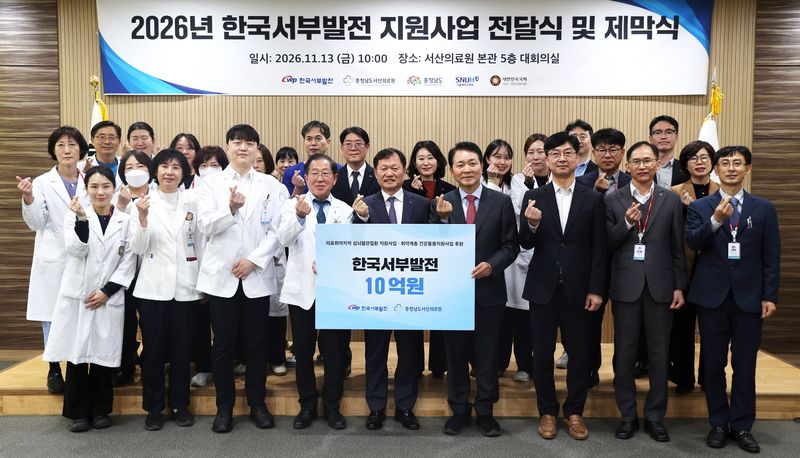
[Financial News] Since Korea Western Power began supporting medical care in Seosan and Taean, South Chungcheong Province, in 2019 alongside Seoul National University Hospital (SNUH) and Seosan Medical Center, the rate of definitive treatment within the region for patients with severe cardiovascular and cerebrovascular conditions has risen by 14.2 percentage points in two years. Transfers by doctor helicopter to large hospitals farther away have also fallen sharply.
Western Power said on the 16th that it held a donation presentation ceremony and plaque-unveiling ceremony to strengthen local public healthcare services at Seosan Medical Center in South Chungcheong Province on the 13th. Around 20 people attended, including Western Power President Lee Jung-bok, People Power Party lawmaker Sung Il-jong (representing Seosan and Taean in South Chungcheong Province), Seosan Medical Center Director Kim Young-wan, Kwon Min-sik, head of the Health Policy Division at the South Chungcheong Provincial Government, and SNUH Professor Song Jin-eon of the Department of Cardiology.
Taean County, home to Western Power’s headquarters and its Taean Power Station, is designated by the Ministry of Health and Welfare as an area with limited access to emergency medical care. As of last year, the county had 1.6 doctors per 1,000 residents, about half the national average of 3.1. In 2024, its cerebrovascular disease mortality rate was 23.8 per 100,000 people, 1.3 times the national average of 18.9. This points to a shortage of local medical services capable of responding to conditions requiring prompt treatment, such as strokes and heart attacks.
Western Power has supported care by SNUH’s specialist medical staff and helped operate Seosan Medical Center’s cardiovascular and cerebrovascular center. It has also provided a visiting physician service, disease-prevention programs, health screenings for vulnerable groups, and assistance with medical and prescription costs. Since 2019, it has invested about 6.7 billion won.
Doctor helicopter transfers fell by about 94%, from 181 in 2019 to 11 last year. The monthly average dropped from 15 to fewer than one. The definitive treatment rate for patients with severe cardiovascular and cerebrovascular conditions in Seosan and Taean rose from 37.8% in 2023 to 52% last year, meaning at least one in two patients were able to complete treatment within the region.
For this project, Western Power received the Prime Minister’s Commendation at the Ministry of Agriculture, Food and Rural Affairs’ “Rural-Urban Exchange Day” last July, as well as a ministerial commendation from the Ministry of Land, Infrastructure and Transport for “Best Practices in Regional Development by Relocated Public Institutions.”
President Lee said, “It is meaningful that the cooperation we have built over seven years with SNUH and Seosan Medical Center has led to tangible results that protect residents’ lives,” adding, “We will continue our support so residents can receive the medical services they need in their own region.”
[email protected] Lee You-beom Reporter