They Said, “We’re Not Coca-Cola,” and Ruled Out Price Cuts... Will Plunging Sales Humble Louis Vuitton? [Luxury Price Story]
- Input
- 2026-11-17 05:00:00
- Updated
- 2026-11-17 05:00:03
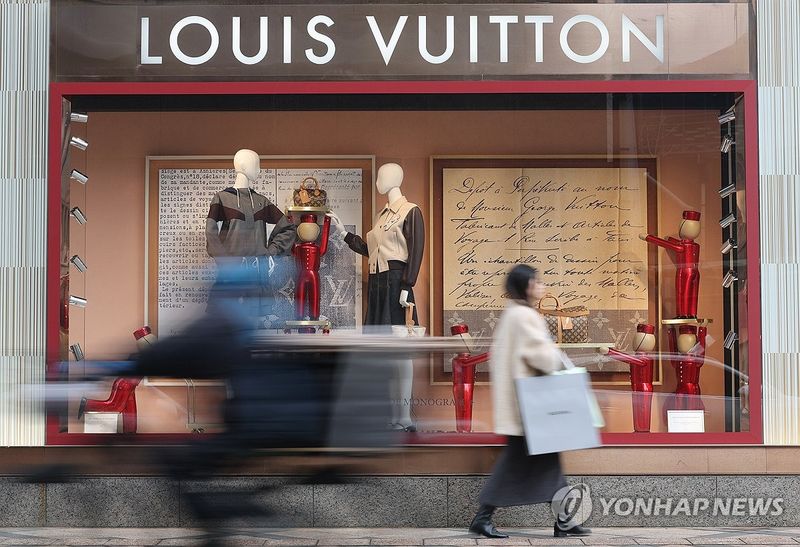
[Financial News] As the downturn in the global luxury market enters its third year, luxury brands are taking different approaches to pricing. Italian luxury brand Gucci has lowered prices on some products to make them more accessible, while French luxury brand Louis Vuitton is holding prices steady out of concern that cuts could damage its brand value.
Luxury slump enters its third year... Gucci has already cut prices by 30%, while Louis Vuitton holds firm
According to The Wall Street Journal (WSJ) and other outlets on the 16th, Gucci has cut prices on some products since this summer. The “Padlock Crystal Small Top Handle Bag,” which sold for 3,500 euros (about 5.15 million won) in France last July, now costs 2,450 euros (about 3.6 million won), a 30% price cut. Gucci has also introduced 16 new bag styles that can be purchased for $2,000 (about 2.67 million won) or less on its official U.S. website.
Kering, Gucci’s parent company, does not see these price cuts as the centerpiece of its recovery strategy. Gucci has struggled with poor performance, with sales declining for 13 consecutive quarters. After sharply raising prices in recent years, Gucci had become increasingly unaffordable for consumers, and the latest cuts are seen as an effort to address that. Analysts say Gucci’s decision to cut prices reflects the pragmatic management style of Kering CEO Luca de Meo, who took the helm last year after leading the auto industry. So far, however, the strategy has yet to produce a sustained rebound in sales.
By contrast, LVMH Moët Hennessy Louis Vuitton (LVMH), the world’s largest luxury goods group and parent company of Louis Vuitton, is taking a different approach from Kering. Rather than lower prices, its strategy is to win customers back by strengthening the competitiveness of its products.
Goldman Sachs analyst Erwan Rambourg said Louis Vuitton had confused consumers by expanding beyond its signature travel bags and handbags into fragrances and cosmetics. In his view, the fundamental problem was business expansion, not pricing.
LVMH discusses price cuts as “bold measures”
However, discussions about price cuts have also begun within LVMH. At a recent earnings presentation, LVMH Chief Financial Officer (CFO) Cécile Cabanis said, “We are discussing bold and immediate measures, such as price cuts, internally.” That marks a sharp contrast with the stance taken just a year ago, when the company dismissed the possibility of price adjustments, saying, “We are not Coca-Cola.” Goldman Sachs estimates that Louis Vuitton, a core brand accounting for at least half of the group’s operating profit, saw third-quarter sales fall by about 8% from the same period last year. That estimate is cited as a reason for the shift.
The fundamental reason both brands are faltering is the departure of middle-class consumers. According to investment bank Bernstein, at least half of Gucci and Louis Vuitton’s sales come from middle-class consumers who spend $2,000–$3,000 a year on luxury goods (about 2.67 million to 4 million won). But as inflation weakened their purchasing power and they tightened their purse strings, sales fell.
The high end, where the ultra-wealthy shop, is “untouched by the downturn”
By contrast, the luxury market serving the ultra-wealthy is thriving. According to Boston Consulting Group (BCG), around 700,000 ultra-wealthy people—0.2% of all luxury customers—account for roughly a quarter (24%) of industry revenue. Top-tier brands that count them as their main customers, including Italian luxury brand Brunello Cucinelli, French luxury jewelry and watch brand Cartier, and Swiss high-end watch brand Patek Philippe, are weathering the downturn.
The WSJ said that “financial pressure on the middle class may be temporary,” but added that “if conditions for middle-class shoppers continue to worsen and the spread of artificial intelligence (AI) continues to darken the job outlook for white-collar office workers, both Louis Vuitton and Gucci will have to rethink their strategies.”
[email protected] Kim Su-yeon Reporter