“No Professional Turf Barriers Should Stand in the Way of Protecting Corporate Technology”... Heads of Korean and British Patent Attorneys’ Associations Speak With One Voice
- Input
- 2026-11-16 18:46:52
- Updated
- 2026-11-16 20:37:58
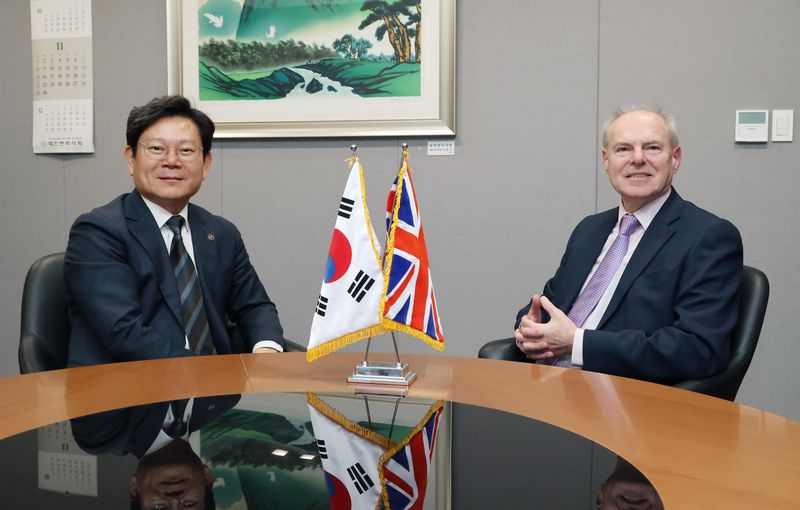
[Financial News]“A patent attorney’s right to confidentiality is not an issue of professional turf between patent attorneys and lawyers; it is an issue for businesses.”Jeon Jong-hak, president of the Korea Patent Attorneys Association, and Simon Wright, president of the UK’s Chartered Institute of Patent Attorneys (CIPA), agreed on the need to introduce patent attorneys’ privilege to protect companies’ technical information. Jeon also called for a system allowing patent attorneys and lawyers to jointly represent clients in litigation, while Wright emphasized guaranteeing companies the right to choose their experts and expanding competition. In particular, they agreed that a legal framework must be established to protect technical advice exchanged between companies and patent attorneys ahead of the implementation of lawyers’ privilege next February.
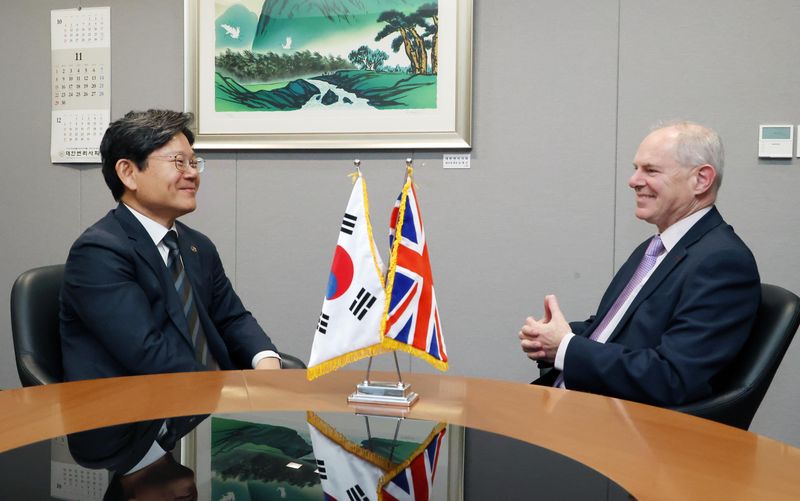
On the 12th, Jeon and Wright held a joint interview with Financial News at the Korea Patent Attorneys Association building in Seocho-gu, Seoul. Comparing the patent litigation systems of South Korea and the UK, they highlighted the need to build a business-centered framework for protecting intellectual property.■ Patent attorneys’ privilege: a safeguard for protecting technologyJeon identified the introduction of patent attorneys’ privilege as an urgent legislative priority. Under the amended Attorney-at-Law Act, lawyers’ privilege will take effect next February, but no equivalent legal protection has been established for patent attorneys.
He pointed out that “if patent attorneys are not granted privilege as lawyers’ privilege is enshrined in law, there is a risk that materials exchanged between companies and patent attorneys in the course of consultations could be disclosed in overseas patent litigation.” He explained that in overseas litigation, whether privilege is recognized in the country where the expert who provided the advice is based can become a key issue in determining whether the materials are protected.
He also cited discussions on expanding the domestic discovery system as another reason legislation was needed. Jeon stressed, “Other trade secrets or core technologies belonging to companies could be exposed in the process of obtaining evidence,” adding, “Minimum safeguards must be put in place before a discovery system is introduced.” Wright also said, “Patent attorneys must be able to provide clients with clear and candid advice, whether the news is good or bad,” and added, “If there is a risk that the advice could be disclosed in litigation, it may become difficult to provide sufficiently thorough advice.”
Under UK law, certain intellectual property-related advice exchanged between patent attorneys and their clients is protected by privilege.
Jeon called for lawyers and patent attorneys to be allowed to jointly represent clients in patent infringement lawsuits. Patent attorneys in South Korea can currently represent clients in actions seeking to overturn decisions by the Intellectual Property Trial and Appeal Board (IPTAB), but they are not authorized to represent clients in civil lawsuits concerning patent infringement.
He said, “The technical issues addressed in patent trials and patent infringement lawsuits are closely connected,” adding, “If patent attorneys and lawyers work together from the outset, they can integrate the preparation for litigation and reduce duplicated costs.”
The UK allows patent attorneys with certain qualifications to take part in intellectual property litigation. Wright highlighted the Intellectual Property Enterprise Court (IPEC), which aims to ease the burden of litigation costs in smaller IP disputes, and the Unified Patent Court (UPC), which handles patent disputes involving multiple European countries.
He explained, “The IPEC is a system designed to enable businesses to obtain judicial remedies more quickly and at lower cost,” adding, “The UPC is useful for resolving patent infringement issues arising in multiple European countries.”
[Profile] Simon Wright, UK Patent Attorneys’ Association President and “Life Sciences Patent Expert With 35 Years of Experience”
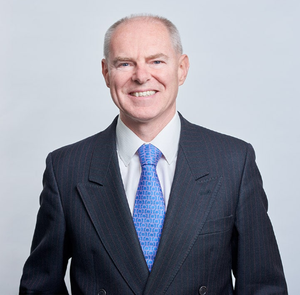
Simon Wright, president of the UK’s Chartered Institute of Patent Attorneys (CIPA), is a UK and European patent attorney with at least 35 years of experience in life sciences, chemistry and pharmaceuticals. He has worked on patent applications and intellectual property protection in advanced biotechnology fields, including stem cells, genes and genomes, new drugs, and gene-editing technology (CRISPR).
After earning a degree in chemistry, including biochemistry, from the University of Bristol in the UK in 1986, he qualified as a UK patent attorney in 1990 and a European patent attorney in 1992. He joined the UK patent law firm J A Kemp in 1994 and became a partner in its biotech group in 2005. In 2022, he moved to Schlich.
He chaired CIPA’s Life Sciences Committee for 20 years and currently chairs the Biotechnology Committee of epi. He also served as a member of SACEPO, an advisory body to the European Patent Office (EPO). He won the 2024 CIPA presidential election, served as vice-president in 2025, and took office as president on January 1 this year.
[email protected] Kim Mi-hee Reporter