Jensen Huang Fallout Sends Samsung Electronics and SK Hynix Tumbling; KOSPI 5,100 Mark Under Threat
- Input
- 2026-11-16 14:09:00
- Updated
- 2026-11-16 14:09:00
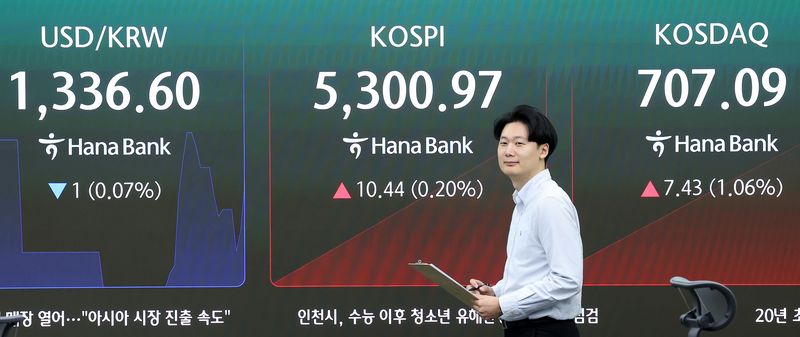
[Financial News] Supply-chain uncertainty following the resignation of former NVIDIA CEO Jensen Huang is weighing on domestic semiconductor stocks. Samsung Electronics and SK Hynix plunged in tandem, pulling the KOSPI down to the 5,100 mark. The market is focused on whether NVIDIA will maintain its existing investment and supply strategies after the leadership change.
As of 1:53 p.m. on the 16th, the KOSPI stood at 5,102.27, down 188.26 points (3.56%) from the previous trading day. It opened higher at 5,305.40 and climbed as high as 5,327.99 during the session, but then turned lower and gave up all its gains. The KOSDAQ was also trading at 671.10, down 28.56 points (4.08%).
Large-cap semiconductor stocks saw steep declines. Samsung Electronics was down 4.66% at 196,400 won, while SK Hynix fell 7.48% to 1,125,000 won. On the Korea Exchange, 647 stocks fell, far outnumbering the 238 that rose.
In the United States, uncertainty over NVIDIA’s management spread across the semiconductor sector. On the 13th (local time), NVIDIA fell 2.0%, extending its losing streak to six consecutive weeks. Its weekly decline reached 13%. AMD, which had been expected to benefit as an alternative, also fell 8.8% that day, while Broadcom (-4.8%), Marvell (-4.7%) and Arm (-4.6%) also declined.
The key issue is whether the supply chain and investment strategy built by former CEO Huang will continue. Tesla CEO Elon Musk warned, “A substantial number of NVIDIA’s major deals were based on personal trust between former CEO Huang and suppliers,” adding, “In his absence, some key supply-chain contracts may not be maintained.” No actual contract disruptions have been confirmed, but uncertainty has also increased for domestic suppliers of high-bandwidth memory (HBM).
Lee Jae-man, a researcher at Hana Securities, cited the possibility of reduced equity investments in AI-related companies as a reason for concern over NVIDIA’s CEO change. He assessed that if the scale of investment shrinks, NVIDIA’s standing as a leader of the AI ecosystem could also be shaken.
Views also differ on whether former CEO Huang should return. According to KB Securities, major investors urged the board to consider succession plans, including Huang’s return. By contrast, U.S. Treasury Secretary Scott Bessent called for a management reshuffle and the recruitment of outside candidates. Caution over supply and investment strategies may persist until the next leadership team is finalized.
Kim Se-hwan, a researcher at KB Securities, said, “The Nasdaq fell as the risk of NVIDIA’s CEO transition spread across the semiconductor sector and the 10-year yield rose further into the 5% range,” adding, “This is a market characterized by capital rotation limited to semiconductors and AI hardware, and volatility may increase until NVIDIA’s earnings announcement.”
[email protected] Choi Doo-seon Reporter