Absences for Regular Treatment to Count as Attendance for Students With Rare or Intractable Diseases
- Input
- 2026-11-16 13:46:28
- Updated
- 2026-11-16 13:46:28
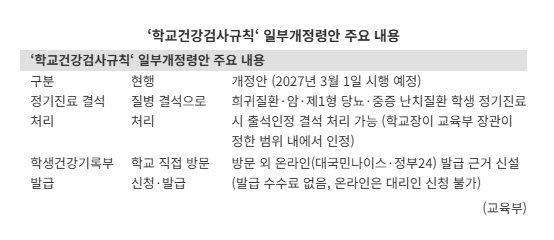
[Financial News] Students with rare diseases or severe intractable diseases will now be able to have absences for regular medical appointments counted as attendance. A legal basis has also been established for issuing student health records online.
On the 16th, the Ministry of Education announced that it would seek public comment for 41 days, from the 17th through December 28, on a proposed partial amendment to the School Health Examination Rules containing these measures. Under the supplementary provisions, the amendment will take effect on March 1 next year.
The amendment would allow school principals to count as attendance the time students with rare diseases, cancer, type 1 diabetes or other severe intractable diseases spend visiting medical institutions for regular treatment, within the scope set by the Minister of Education. The applicable diseases include rare diseases as defined under the Rare Disease Management Act.
According to the Ministry of Education, about 49,000 patients aged 7 to 18 have these diseases. Based on the Korea Disease Control and Prevention Agency’s Rare Disease Helpline, there are 1,389 rare diseases, while 234 severe intractable diseases are listed under Annex 4-2 of the special provisions for calculating patients’ partial copayments.
The Ministry of Education explained, “There have been unfortunate cases in which some students felt burdened by absences for regular treatment being recorded as illness-related absences and avoided necessary treatment to reduce the number of days absent.” The ministry plans to use this new legal basis to ease students’ concerns about absences being recorded and create an environment where they can focus on recovering their health while continuing their studies.
A legal basis will also be established for issuing student health records online, whereas previously they could only be obtained by visiting a school in person. Student health records are official documents containing vaccination histories, physical development information and health examination results. The Ministry of Education plans to introduce an application form and later establish an online issuance system through the public-facing NEIS portal and Government24. The form included in the proposed amendment states that there will be no issuance fee and that online applications cannot be submitted by proxy.
Education Minister Choi Kyo-jin said, “Helping sick students continue their studies while they work to recover their health is a basic part of education,” adding, “We will continue to listen to even the smallest voices from schools, pursue necessary institutional improvements and create an educational environment that satisfies both students and parents.”
[email protected] Kim Man-gi Reporter