AI Investment Jitters Hit Markets Hard ... KOSPI Tumbles in 3% Range, Large-Caps Also Plunge [fn Afternoon Market]
- Input
- 2026-11-16 13:48:33
- Updated
- 2026-11-16 13:48:33

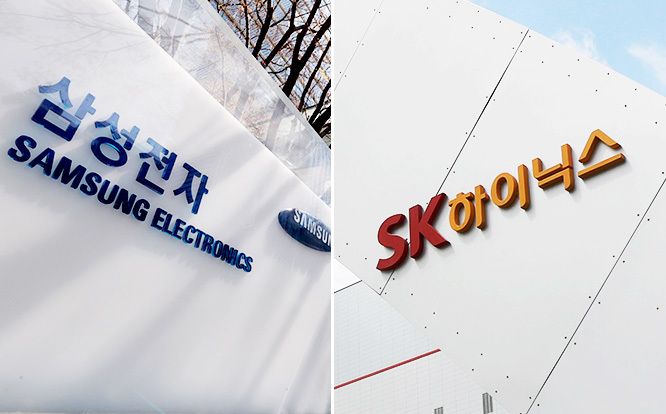
[Financial News] South Korea’s stock market is reeling once again amid uncertainty over AI investment originating in the United States and concerns about interest rates. With the KOSPI and KOSDAQ both down around 3%, top market-cap stocks, including semiconductor heavyweights Samsung Electronics and SK hynix, were broadly weaker.
Doubts about the profitability of the AI industry are spreading across related sectors, including semiconductors, power and secondary batteries, and investor sentiment is rapidly freezing.
As of 1:34 p.m. on the 16th, the KOSPI was down 161.36 points (3.05%) from the previous trading day at 5,129.17. It briefly slid to the low 5,000s intraday and continued to trade uneasily. The KOSDAQ was also down 24.92 points (3.56%) at 674.74.
Weakness across the AI value chain ... Large-cap semiconductor stocks take a direct hit
Losses among large-cap stocks were pronounced. Samsung Electronics traded down 4.03% at 197,700 won, while SK hynix fell 6.91% to 1,132,000 won, compared with the previous trading day. SK Square (-7.19%), Samsung SDI (-5.92%), Doosan Enerbility (-4.55%) and Samsung Electronics preferred shares (-4.11%) also fell sharply. Other major large-cap stocks, including LG Energy Solution (-2.16%), Samsung C&T (-0.88%) and Hyundai Motor (-0.33%), were also weaker.By contrast, some stocks moved differently: Hanwha Aerospace rose 2.96% and Kia gained 0.95%. Samsung Biologics was also up 0.35%.
Kang Jin-hyuk, a senior researcher at Shinhan Investment & Securities, said, “With risks surrounding NVIDIA persisting, weakness is spreading across the AI value chain, including semiconductors and neoclouds.”
The U.S. Producer Price Index (PPI) for October came in below expectations, but its 6.5% year-on-year rise—the highest in four years—was also cited as a headwind. The assessment is that macroeconomic uncertainty has grown as the U.S. 10-year Treasury yield broke above 5.15%.
Foreign selling pressure is also evident in trading flows. In KOSPI trading this afternoon, foreign investors are net sellers of 1.6007 trillion won. Institutional investors are also net sellers, by 95.1 billion won. Individuals are absorbing the selling by buying a net 1.4001 trillion won, but that appears insufficient to stop the index’s decline.
On the KOSDAQ, foreign investors were net sellers of 321 billion won, while individuals were net buyers of 431 billion won. Institutional investors were also net sellers, by 94.6 billion won.
Researcher Kang also said the KOSDAQ had retreated to the 670 level as losses widened among large-cap stocks in materials, parts and equipment, as well as biotech. Selling pressure is spreading beyond AI-related stocks to growth stocks more broadly.
Asian markets also weaken in tandem amid AI uncertainty
Asian markets were also weak, not just South Korea’s. At the same time today, Japan’s Nikkei 225 was down 1.65%, Taiwan’s TAIEX fell 4.73%, and China’s Shanghai Composite Index dropped 0.38%. Only Hong Kong’s Hang Seng Index managed a relative gain, rising 0.84%.Losses were especially pronounced in markets with high weightings of technology stocks, such as Japan and Taiwan. Debate in the United States over the investment profitability of the AI industry is spreading into valuation concerns across global semiconductor and technology stocks, putting downward pressure on Asian markets as well.
Doubts about the sustainability and profitability of investment in the AI industry remain unresolved, while concerns about U.S. interest rates are adding to the strain, delaying a recovery in investor sentiment across domestic and overseas markets.
With foreign selling of large-cap semiconductor stocks continuing, the performance of global AI-related stocks and foreign investor trading flows are seen as key factors that will determine the direction of South Korea’s stock market for the time being.
[email protected] Kang Jung-mo Reporter