'Insurrection Reckoning' Returns to Center Stage... Ruling Party Highlights Calls for Cho Hee-dae to Take Responsibility
- Input
- 2026-11-16 12:04:56
- Updated
- 2026-11-16 12:04:56
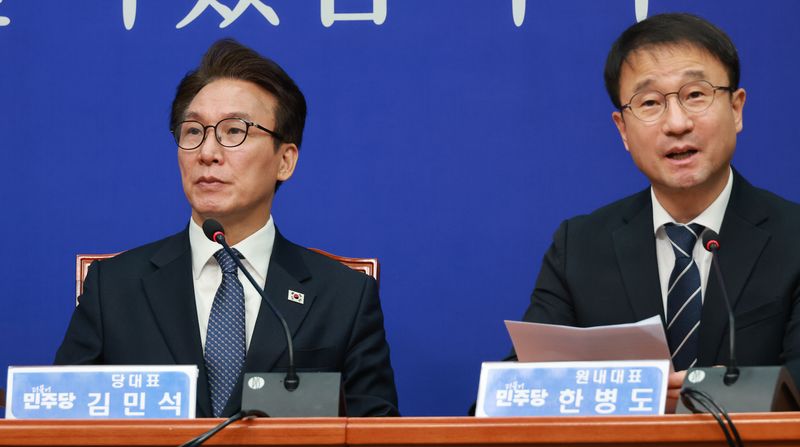
DPK leader Kim Min-seok said at a Supreme Council meeting at the National Assembly of the Republic of Korea that it was “long overdue” for the Supreme Court of Korea to set the 19th—the day before Han Duck-soo's detention period expires—as the date for its ruling on Han's appeal of his charge of performing key duties in the insurrection. He nevertheless criticized the court, saying, “I hope the court will engage in deep reflection on the situation, in which public concern has grown that Han Duck-soo might be released because the Supreme Court has delayed the trial to an extent that is hard to accept.” DPK floor leader Han Byung-do also cited the appellate ruling last May, in which former Prime Minister Han was sentenced to 15 years in prison for performing key duties in the insurrection, and urged the court to act: “More than half a year has passed without a conclusion, and we have reached the point of having to worry about a release. Chief Justice Cho Hee-dae must clearly answer for the current situation.”
The possibility of Lee Sang-min, former Minister of the Interior and Safety, being released was also raised, as his detention period expires on the 18th of next month. Lee was sentenced to nine years in prison at the appellate trial on charges related to orders to cut off power and water to media outlets during the 2024 South Korean martial law crisis. He is now awaiting a ruling by the Supreme Court of Korea's Grand Bench.
Han Byung-do criticized the court, saying, “In the three months since the case was referred to the Grand Bench, a hearing has been held only once. How long must the public continue to feel anxious that insurrection participants may be released one after another?”
The DPK plans to focus its questioning on the circumstances behind the trial delays and measures to address the expiration of detention periods at an emergency hearing of the National Assembly's Legislation and Judiciary Committee.
The ruling party leadership's pressure on the judiciary is also linked to President Lee Jae Myung's efforts to bring the insurrection to account. With reports that President Lee is considering ordering the formation of a special investigation headquarters targeting the remaining forces behind the insurrection after his overseas trip this week, the DPK has also put the judiciary's responsibility for delays in insurrection trials front and center.
As investigations into the remaining forces through the special investigation headquarters and court proceedings in insurrection cases involving Han Duck-soo and Lee Sang-min become intertwined, reckoning with the insurrection is expected to reemerge as a major political issue ahead of the second anniversary of the 2024 South Korean martial law crisis.
[email protected] Jiwon Song Reporter