"A Foothold for Attracting a Second Round of Public Institutions"... Naepo New Town in South Chungcheong Tops 50,000 Residents
- Input
- 2026-11-16 12:25:48
- Updated
- 2026-11-16 12:25:48
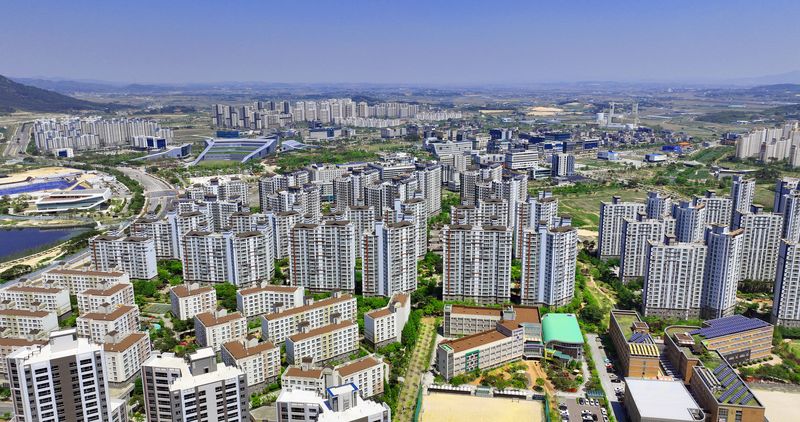
According to South Chungcheong Province on the 16th, as of the 13th Naepo New Town had a total population of 50,005, including 49,244 Korean nationals (registered residents) and 761 foreign residents (registered foreign nationals and overseas Koreans with foreign nationality).
Naepo New Town had just 509 residents at the end of 2012, the first year the South Chungcheong Provincial Government had relocated, but its population grew rapidly to 10,950 at the end of 2015 and 20,162 at the end of 2016. After maintaining modest growth in the 20,000s, it surpassed 30,000 in October 2022, recording 30,338—six years after first passing the 20,000 mark. In particular, after topping 40,000 in October 2024, it added another 10,000 in just two years, charting a steep growth curve.
By administrative district, 36,075 Korean nationals lived in Hongbuk-eup (Singyeong-ri), Hongseong County, and 13,169 in Sapgyo-eup (Mok-ri), Yesan County. The population was perfectly balanced by gender, with 24,631 men and 24,613 women—a 50-50 split.
Young people, who form the core of the workforce and child-rearing population, make up a dominant share of residents. The age groups ranked as follows: people in their 40s, 19.2% (9,462); 30s, 19% (9,380); 50s, 14.4% (7,105); teens, 13% (6,421); under 10, 12% (5,900); and 20s, 9.4% (4,624). Residents in their 40s or younger account for 72.7% of the total (35,787), giving the new town the characteristic profile of a young city, with parents in their 30s and 40s settling alongside young children. There are 564 foreign residents in Hongbuk-eup and 197 in Sapgyo-eup.
The population surpassing 50,000 is an achievement that directly overcomes community concerns that delays in the government's second relocation of public institutions from the Seoul metropolitan area could weaken the town's growth momentum. South Chungcheong Province has not relied solely on the relocation of public institutions; instead, it has focused its administrative efforts on bringing together provincial-level affiliated institutions and organizations, building industry-academia-research clusters, and supplying pleasant residential complexes. The analysis is that proactively building the infrastructure for daily life so that people with genuine housing needs from the surrounding old downtown areas of Hongseong and Yesan, as well as the Seoul metropolitan area and the Daejeon-Sejong region, can settle there has served as the real driver of population growth.
As of the end of last September, 142 institutions and organizations had set up in Naepo New Town, employing a total of 6,339 people. The housing base is also taking shape: 27 of the 44 planned apartment-housing blocks (24,078 households) have been completed, while another 14 blocks are undergoing construction and permitting procedures, leaving ample room for further population inflows.
Cultural, sports and medical infrastructure is also gradually taking shape. Following the Chungnam Library and Chungnam Sports Center, which are already in operation, the Chungnam Museum of Art and international tennis courts will open next year, followed by the Chungnam Arts Center in 2030. In the medical field, long a top priority for residents, the first phase of the comprehensive medical facility, 'Naepo Children's Hospital,' is expected to begin seeing patients in October 2028, significantly improving residential satisfaction for young couples.
South Chungcheong Province expects that the goal of reaching a population of 100,000 by 2030 will be readily achievable if it succeeds in attracting key institutions in the second relocation of public institutions from the Seoul metropolitan area, which is expected to be announced within the year.
At the sixth meeting of heads of bureaus, offices and agencies held that day, South Chungcheong Province Governor Park Soo-hyun said, "Surpassing 50,000 residents is a solid foundation for attracting public institutions and a decisive opportunity for South Chungcheong and Naepo to take another leap forward. Just as Sejong is moving toward completing its role as the administrative capital, Naepo, too, must go beyond being an innovation city and become a future artificial intelligence (AI) city by attracting public institutions." He added, "Let's maximize the strengths of Naepo as a 'ready city' and respond proactively with a meticulous strategy for attracting institutions so that we can gain an edge in competition with other cities and provinces."
[email protected] Kim Won-jun Reporter