“Mandu Instead of Dumpling”: Flitto Inc. Lowers Language Barriers for Tourists
- Input
- 2026-11-16 11:11:00
- Updated
- 2026-11-16 11:11:01
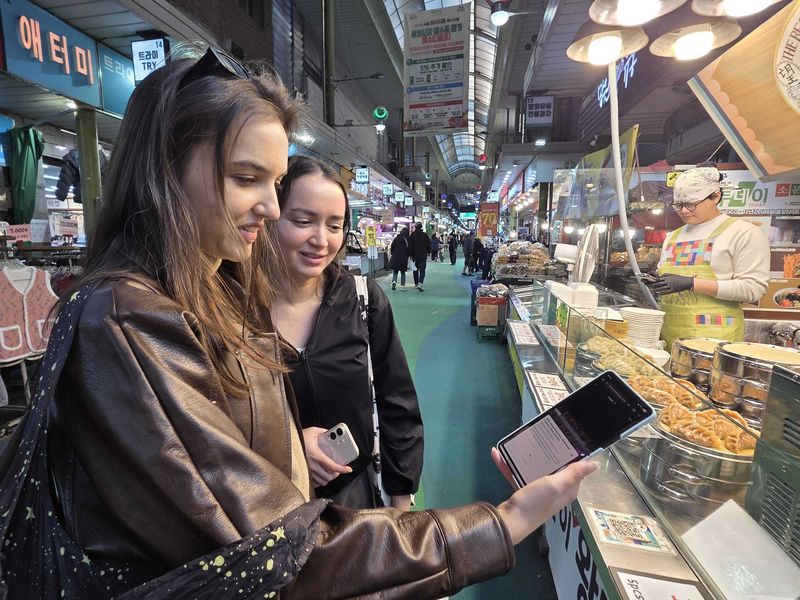
[Financial News] Artificial intelligence (AI) interpreting and translation technology is being used to lower language barriers at traditional markets. The service helps foreign tourists understand food menus easily and communicate with vendors in real time, even if they do not know Korean. It is expected to make traditional markets more convenient for foreign tourists and contribute to revitalizing local commercial districts.
According to industry sources on the 16th, Flitto Inc. supplied AI-powered multilingual interpreting and translation features for the “AI Tourism Butler” service being promoted by the Korea Tourism Organization (KTO).
The project was launched to remove language barriers and support the digital transformation of traditional market businesses as more foreign tourists visiting Korea go to traditional markets.
Flitto Inc.’s AI interpreting and translation service has been introduced at food stalls in four traditional markets nationwide, including Mangwon Market and Gyeongdong Market in Seoul, Haeundae Market in Busan, and Andong Old Market in North Gyeongsang Province.
Menu translations are available in 10 languages, including English, Chinese and Japanese, as well as Arabic, Mongolian and Thai. When foreign tourists access a map via a QR code, menu information is automatically displayed in the language set on their smartphone or other device.
For dishes without photos, the service provides AI-generated preview images along with multilingual menu descriptions and allergy precautions. A key feature is that it offers information to help users understand the food, rather than simply translating menu names.
The service also focuses on preserving the distinctive names and cultural characteristics of Korean food. Flitto Inc. used menu data accumulated through collaborations with local governments, including Busan City and Jeonju City, and incorporated the KTO’s standard translation guidelines.
For example, dumplings are labeled with the distinctive name “Mandu” rather than the generic English term “Dumpling.” For kimchi in Chinese, the service also uses the standard transliteration “Shinchi,” distinguishing it from “Paocai,” which refers to Chinese pickled vegetables.
Image translation technology that analyzes text in menu photos alongside the surrounding context has also been introduced. This allows expressions that could be interpreted in other ways, such as “yeolgi,” a fish name, to be translated in the context of food.
The service also supports real-time interpreting between tourists and vendors. Foreign tourists can ask questions in their own language and vendors can respond in Korean, helping reduce communication difficulties when explaining menus and placing orders.
[email protected] Jang Min-kwon Reporter