Seoul Row Houses and Multi-Family Homes Rise More Than Apartments...Gap in Year-to-Date Gains Also Narrows
- Input
- 2026-11-16 14:21:41
- Updated
- 2026-11-16 14:21:41
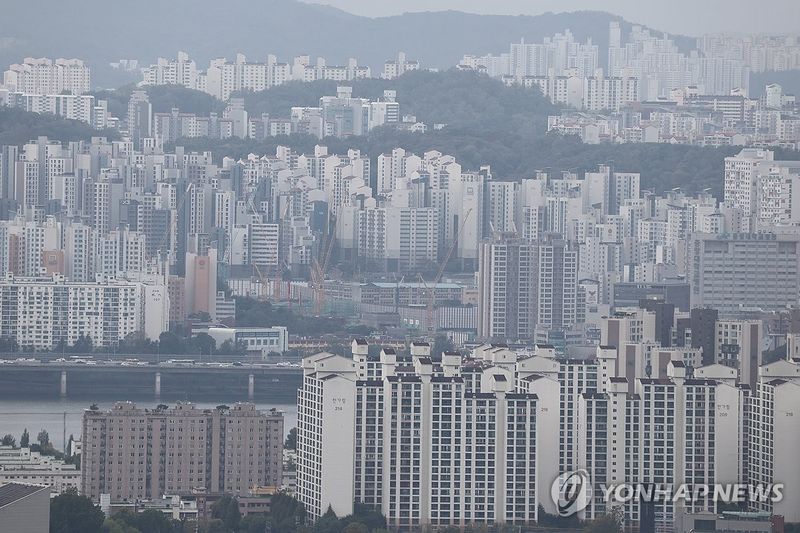
According to the Korea Real Estate Board on the 16th, overall home sale prices in Seoul rose 0.65% from the previous month. By housing type, row houses and multi-family homes posted the largest increase, at 0.85%, followed by apartments at 0.54% and detached and multi-household homes at 0.49%.
■ Row houses and multi-family homes up 8.25% year to date, narrowing gap with apartments to 0.65 percentage points
Compared with the same period last year, the cumulative gain for apartments increased by 1.73 percentage points, while that for row houses and multi-family homes widened by 4.82 percentage points. Prices for detached and multi-household homes rose from 2.55% last year to 4.28% this year, an increase of 1.73 percentage points.
The cumulative gain in overall Seoul housing prices rose from 5.42% last year to 8.27% this year.
However, monthly gains have been declining for four consecutive months. The monthly increase in overall Seoul home sale prices fell from 1.09% in July to 0.97% in August, 0.84% in September and 0.65% in October. Apartment price gains also slowed over the same period, from 1.27% to 1.05%, 0.74% and 0.54%. For row houses and multi-family homes, the increase narrowed from 1.03% in September to 0.85% in October, but remained higher than for apartments.
■ Gains in Seodaemun and Nowon, Despite Declines in Gangnam and Seocho
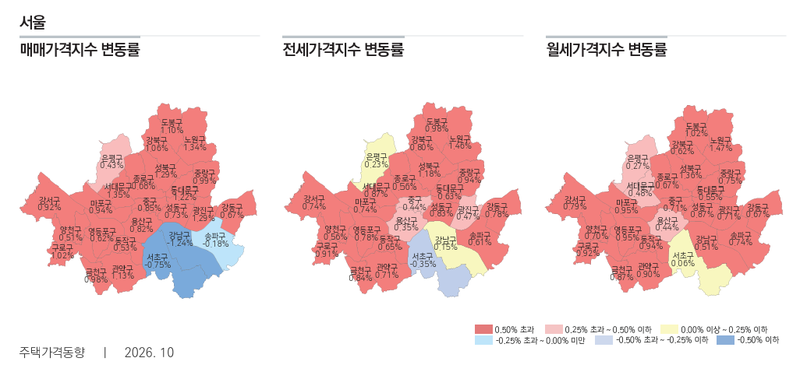
There were marked differences among areas of Seoul. For overall housing, prices fell 1.24% in Gangnam District, mainly in Apgujeong and Daechi-dong, and 0.75% in Seocho District, primarily in Banpo and Jamwon-dong.
By contrast, prices rose 1.35% in Seodaemun District, particularly among small- and medium-sized homes in Hongje-dong and Namgajwa-dong. They rose 1.34% in Nowon District, 1.29% each in Seongbuk District and Gwangjin District, and 1.22% in Dongdaemun District. Gwanak District, at 1.13%, Guro District, at 1.02%, and Geumcheon District, at 0.98%, also posted gains.
The Korea Real Estate Board said trends diverged by area and housing complex: while lower-priced listings and adjusted transactions appeared in some areas, contracts at higher prices were signed in popular locations, including large complexes and areas near subway stations.
■ Apartments Post the Largest Gains in Jeonse and Monthly Rents
In the rental market, apartments recorded the largest increases. In Seoul, apartment jeonse prices rose 0.76% in October and monthly rents rose 0.89%. For row houses and multi-family homes, jeonse prices rose 0.58% and monthly rents 0.65%; for detached and multi-household homes, the increases were 0.37% and 0.42%, respectively.
Overall jeonse prices in Seoul rose 0.68%, and monthly rents rose 0.77%. Cumulative gains this year were 7.42% for jeonse and 7.34% for monthly rents, up 5.50 percentage points and 5.13 percentage points, respectively, from 1.92% and 2.21% over the same period last year.
The Korea Real Estate Board said nationwide jeonse and monthly rents both rose as demand from tenants continued, particularly in areas with good transport and living conditions, such as those near subway stations and large housing complexes.
Meanwhile, nationwide overall home sale prices rose 0.28% in October from the previous month. Jeonse prices rose 0.34% and monthly rents rose 0.40%, with both the sales and rental markets posting gains.
[email protected] Choi Ga-young Reporter