Reform Party Says CSAT Should Be Postponed, Calls for Measures Against AI Cheating
- Input
- 2026-11-16 10:06:47
- Updated
- 2026-11-16 10:06:47
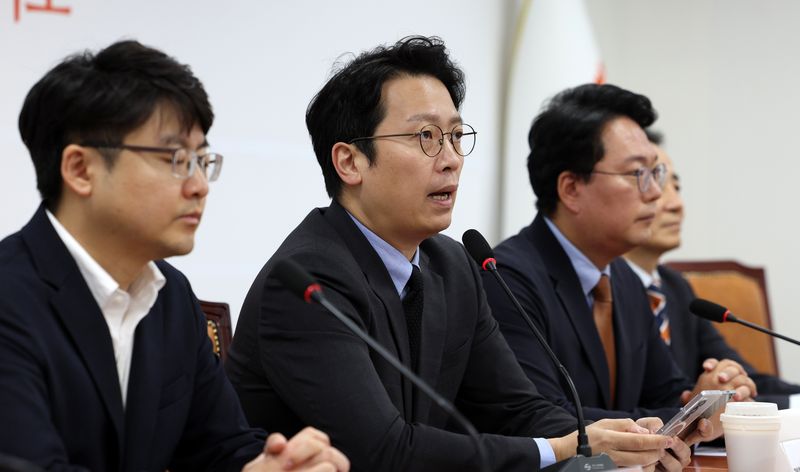
[Financial News] A call has emerged within the Reform Party to postpone the 2027 College Scholastic Ability Test (CSAT), scheduled for the 19th, with just three days to go before the exam. Concerns about the fairness of the CSAT are also growing after the top-scoring candidate in the tax accountant exam admitted to cheating with the help of artificial intelligence (AI). Amid this, the first call in political circles to consider postponing the CSAT has emerged.
Lee Gi-in, chair of the Reform Party’s emergency committee, wrote on social media (SNS) on the 16th that “the fairness of South Korea’s college admissions process is being shaken just three days before the CSAT,” and said postponement should be considered.
He said, “Students who have studied honestly are afraid that someone might cheat using AI glasses, while students who wear ordinary glasses are worried that they might be suspected of cheating during the exam and have their concentration disrupted.” He asked, “What kind of world is this, where students who have done nothing wrong are instead trembling with anxiety because of cheating? Is this normal?”
The committee chair pointed out, “The government’s proposed measure is to assign dedicated staff at each test site to screen for smart glasses,” adding, “But cheating using miniature cameras and communications devices has already been uncovered. Is checking glasses alone really enough?”
He continued, “Technology is advancing by the day, but the government’s measures still rely on the human eye. We may be able to hold proctors responsible, but how are teachers at the test sites supposed to detect every technology the state has failed to prepare for?”
The committee chair stressed, “In the worst case, we should even consider postponing the CSAT. If we conclude that fairness can be guaranteed in the near future, the exam can go ahead as scheduled. But if not, we must make a responsible decision about postponement and adjustments to the subsequent admissions schedule.”
Chun Ha-ram, the Reform Party’s floor leader, went a step further than the call to consider postponing the CSAT at its emergency committee meeting that day.
Chun said, “Postponing the CSAT is absolutely necessary,” and argued, “We must postpone the exam and put in place a minimum system to prevent AI cheating.”
He expressed concern, saying, “The Ministry of Education reportedly plans to assign one dedicated staff member to each of the 1,312 CSAT test sites to determine whether test-takers are wearing AI glasses. Measures of this kind are not enough.” He added, “It is entirely possible to bring in miniature cameras, earphones and other devices on one’s person, and since there is no radio-wave detection even when AI is used to cheat, there is no way to detect it with the naked eye.”
Chun added, “We must not ignore the earnest pleas of test-takers asking for systematic measures to prevent AI cheating, even if that means delaying the exam.”
He explained, “China has already introduced measures for its national college entrance exam, the gaokao, to completely prevent electronic devices from being brought in by using security checkpoints and metal detectors, and to block wireless signals at exam sites.” He added, “It even detects illegal radio transmissions with drones and, during the exam period, disables AI-powered image-answering functions to prevent AI from solving questions in real time.”
Chun pointed out, “Essential measures must be taken to prevent electronic devices from being brought in and used altogether, including metal detector screening and searches of belongings.” He added, “If necessary, we should consult Chinese authorities, who have built up expertise, and take these essential measures quickly and effectively. Since most equipment used for AI cheating is made in China, we need to swiftly benchmark China’s expertise.”
[email protected] Lee Hae-ram Reporter