KOSPI Fails to Hold the 5,300 Level; AI Sentiment Wavers, and KOSDAQ Gives Back the 700 Mark [fn Morning Market]
- Input
- 2026-11-16 09:54:17
- Updated
- 2026-11-16 09:54:17
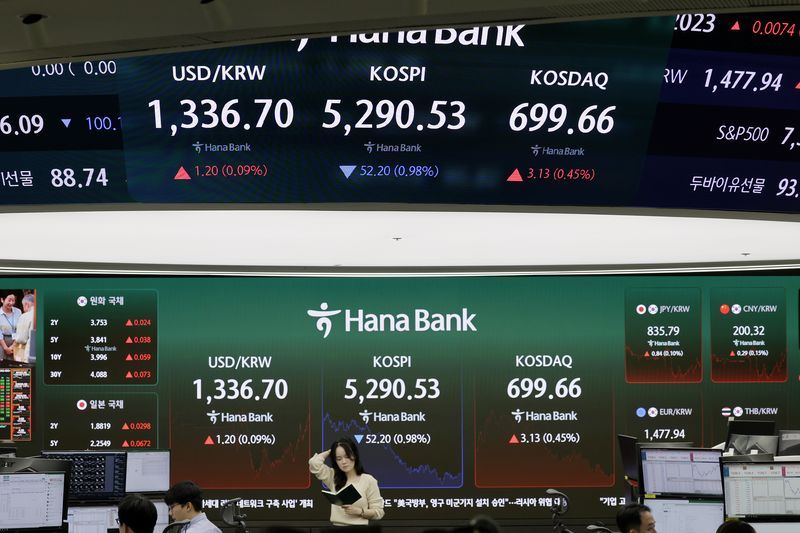
[Financial News] South Korea’s stock market opened higher but failed to sustain its early-session rebound and is trending lower.
The KOSPI recovered the 5,300 level just after the market opened but soon gave back its gains. The KOSDAQ also retreated after rising above 700. Weakness in major semiconductor stocks, particularly SK hynix and SK Square, is limiting the indexes’ rebound.
According to the Korea Exchange, as of 9:49 a.m. on the 16th, the KOSPI stood at 5,280.87, down 9.66 points (0.18%) from the previous trading day.
The index, which had fallen to 5,276.99 at 9:41 a.m., pared its losses slightly but failed to recover the 5,300 level. The KOSDAQ extended its losses, falling 10.94 points (1.56%) to 688.72. It climbed above 700 early in the session but fell below even 690 as selling continued.
Market-cap leaders showed mixed performance. Samsung Electronics rebounded, rising 0.49% to 207,000 won, while its preferred shares gained 1.29%.
SK hynix fell 1.64% to 1,196,000 won, while SK Square dropped 3.67% to 734,000 won. Hanwha Aerospace also plunged 4.68%, while Hyundai Motor and Kia fell 0.93% and 1.27%, respectively.
Samsung SDI and Celltrion were among the gainers, but weakness in major semiconductor and defense stocks is weighing on investor sentiment across the market.
The pressure first emerged among U.S. tech stocks. According to a global index futures report released that day by Samsung Futures, investor sentiment toward AI-related tech stocks has weakened recently, sending shares such as AMD and Broadcom—which had risen on expectations of benefiting from NVIDIA—sharply lower.
In particular, concerns over AI data center operators’ funding needs came to the fore. CoreWeave said after reporting earnings that it was pursuing a $4 billion investment-grade corporate bond offering. This was followed by comments from NVIDIA-backed neocloud provider Nebius, which cited a need for additional funding ahead of its initial public offering (IPO), adding to the concerns.
Jeong Hee-chan, a researcher at Samsung Futures, said, “Concerns over uncertainty surrounding the circular financing structure also spread after Jensen Huang’s resignation, weighing on investor sentiment.” He explained that mounting questions about the amount of capital and financing structures needed before AI infrastructure investments generate actual returns are once again highlighting valuation concerns for related companies.
However, some analysts said risk aversion had not risen sharply across the market. Jeong said, “It appears the options market had little effect in pricing in higher future volatility, and we believe anxiety across the market did not increase meaningfully.”
The rise in the Volatility Index (VIX), too, appears to have been mechanically driven by the decline in stock indexes rather than by an increase in overall market fear.
Key events that could sway investor sentiment toward AI are scheduled for this week. The main ones are NVIDIA’s earnings announcement and developments related to Anthropic’s IPO. Jeong said it would be worth watching whether these major events, including NVIDIA’s earnings and Anthropic’s IPO, can help revive investor sentiment toward AI.
Those in the financial investment industry believe the near-term direction of South Korea’s stock market depends on whether investor sentiment toward AI, particularly in the semiconductor sector, recovers. Whether the KOSPI regains 5,300 and the KOSDAQ 700, as well as changes in foreign investor flows ahead of NVIDIA’s earnings, are key factors in any recovery in sentiment.
[email protected] Kang Jung-mo Reporter