Number of Multi-Unit Property Sellers Falls... Sellers Holding Properties for More Than 20 Years Rise 11.9%
- Input
- 2026-11-16 09:51:44
- Updated
- 2026-11-16 09:51:44
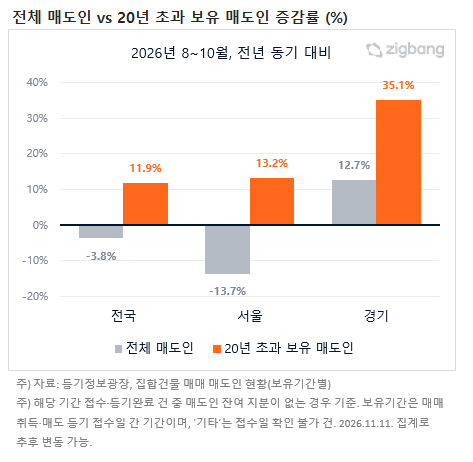
[Financial News] The number of sellers of multi-unit buildings nationwide fell year on year over the past three months, while the number of long-term owners who had held their properties for more than 20 years actually rose. In Seoul in particular, total sellers fell by double digits, but the number of sellers who had held their properties for more than 20 years increased, showing contrasting trends depending on the holding period.
On the 16th, real estate platform Zigbang said an analysis of data from the Court Registry Information Plaza showed that 150,529 sellers of multi-unit buildings nationwide were recorded from August to October, down 3.8% from the same period a year earlier. By contrast, the number of sellers who had held their properties for more than 20 years reached 13,162, up 11.9%. Their share of all sellers also rose 1.2 percentage points, from 7.5% last year to 8.7% this year.
The analysis covered completed cases among registrations filed over the three-month period from August, when the tax reform proposal was announced, through October, for which the latest statistics were available.
During this period, the number of sellers of multi-unit buildings in Seoul fell 13.7% from the same period a year earlier. By contrast, the number of sellers who had held their properties for more than 20 years rose 13.2%. The share of long-term holders among all sellers also reached 13.8%, up 3.3 percentage points from last year.
Sales by owners who had acquired homes relatively recently fell sharply. In Seoul, the number of sellers who had held their properties for five years or less fell 43.2% year on year. The steepest decline was among those who had held their properties for more than four years and up to five years. In the more-than-10-years-to-20-years-or-less holding period, figures were mixed, and the increase in sales by owners who had held their properties for more than 20 years stood out more than that among long-term holders overall.
Unlike Seoul, Gyeonggi Province also saw an increase in the total number of sellers. From August to October, the number of sellers of multi-unit buildings in the province rose 12.7% from the same period a year earlier, while the number of sellers who had held their properties for more than 20 years increased 35.1%. The share of long-term sellers also rose from 6.6% to 8.0%. By contrast, the number of sellers who had held their properties for five years or less fell 14.0%.
Differences by holding period were also seen outside Seoul and Gyeonggi Province. In Daejeon, the total number of sellers edged down, but the number of sellers who had held their properties for more than 20 years rose 19.9%. Daegu and Incheon also saw an increase in long-term sellers amid a decline in total sellers.
However, the increase in sales by long-term holders was not seen nationwide. In Ulsan, the number of sellers who had held their properties for more than 20 years fell 31.0% from the same period a year earlier. The figures also fell 14.5% in South Chungcheong Province and 10.4% in Gangwon Province.
Regional differences were also evident in the monthly trends. Nationwide and in Gyeonggi Province, the number of sellers who had held their properties for more than 20 years rose for two consecutive months between August and October. In Seoul, it edged up in September before turning downward in October.
Zigbang explained, “Even in the same market, conditions for selling can vary depending on when a property was acquired,” adding, “Long-term owners in areas where prices have risen over time have more room to consider realizing gains and moving to another home, among other options.”
[email protected] Choi A-young Reporter