South Chungcheong Province Registers IP Rights for New Climate-Responsive Ginseng Varieties 'Geumhyang' and 'Geumganghyang'
- Input
- 2026-11-16 09:05:59
- Updated
- 2026-11-16 09:05:59
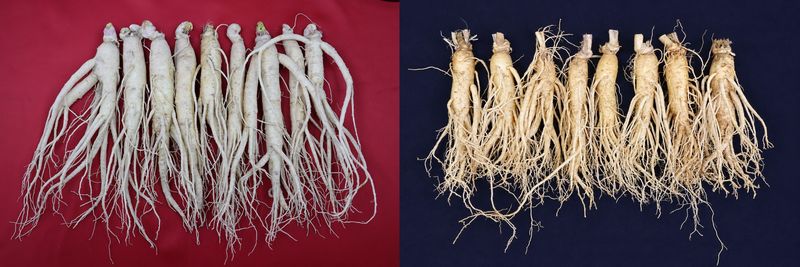
The Ginseng and Medicinal Plant Research Institute of the South Chungcheong Province Agricultural Research and Extension Services said on the 16th that it had completed registration of plant variety protection rights for its in-house-bred ginseng varieties Geumhyang and Geumganghyang on the 22nd of last month. With the registration, the institute has secured exclusive rights to the new varieties while laying the groundwork for a stable supply of high-quality seeds optimized for changing domestic growing conditions.
Ginseng takes a long time to grow, requiring 4–6 years from sowing to harvest, and is extremely sensitive to weather and soil conditions. As torrential rains and unusually high temperatures have become more frequent in recent years, waterlogging damage caused by overly wet soil and losses from various pests and diseases have surged, making the development of resilient new varieties an urgent priority.
The newly registered Geumhyang is resistant to waterlogging, making it suitable for cultivation in paddy fields, which generally drain less well than upland fields. It also has a low incidence of red discoloration, a condition in which the root skin turns red and the ginseng loses market value. In particular, its levels of the key active ingredients ginsenosides (Rg2, Re and Rb1) are markedly higher than those of existing control varieties, giving it strong potential for use as a high-value-added biomaterial in functional health foods and cosmetics. The other newly registered variety, Geumganghyang, is highly resistant to red discoloration and leaf spot, a major disease. Its yield per unit area is about 18% higher than that of existing landraces, and it is expected to contribute significantly to stable farm output and tangible income gains even as weather conditions worsen.
South Chungcheong Province, home to Geumsan County—a key hub of national ginseng production and the country's largest collection center—has long faced continuous-cropping damage as pests and diseases build up in the soil, as well as a shortage of new growing areas, amid a longstanding focus on upland cultivation. As a result, the area devoted to 'paddy-field ginseng'—growing ginseng in fields previously used for rice—has steadily increased. However, existing landraces are vulnerable to moisture, leading to sharp drops in yields. The registration of these new varieties is drawing attention as a tailored solution to these changes in growing practices.
Following the registration of the plant variety protection rights, the South Chungcheong Province Agricultural Research and Extension Services plans to establish standard cultivation guidelines suited to the growth characteristics of the two varieties and gradually expand their distribution to farmers across the province through the creation of seed-production plots and seed propagation.
Kim Min-hee, an agricultural researcher at the Ginseng and Medicinal Plant Research Institute of the provincial agricultural research and extension service, said, "The development of these new varieties is significant because it gives ginseng farmers facing difficulties securing growing areas due to continuous-cropping damage a new option." She added, "We will continue to develop high-quality varieties that meet on-the-ground demand, expand their distribution to farms and their industrial use, and strengthen the competitiveness of ginseng from South Chungcheong Province."
[email protected] Kim Won-jun Reporter