Even Movement Data Tied to Japan's Prime Minister's Office and JSDF Was Sold ... Smartphones Breach Japan's Security
- Input
- 2026-11-16 09:08:46
- Updated
- 2026-11-16 09:08:46
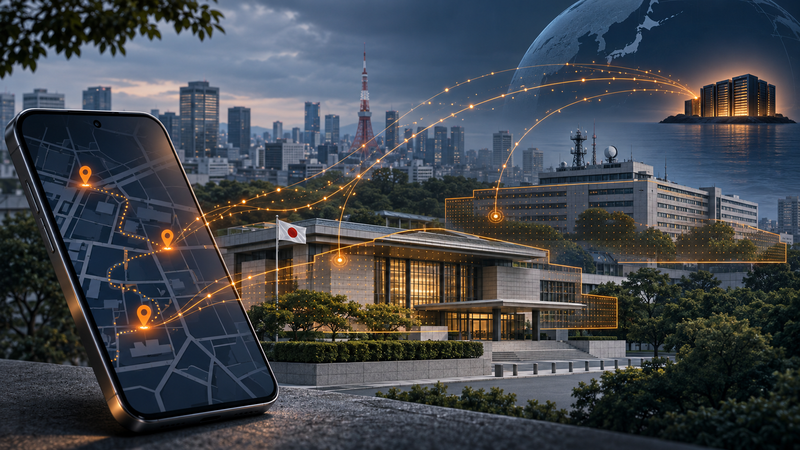
【Financial News, Tokyo—Correspondent Seo Hye-jin】Smartphone location data containing records of visits to Japan's Prime Minister's Office and JSDF bases has been found to be traded overseas. Cross-referencing anonymized movement records with property registries and personnel files made it possible to identify even JSDF officers. Concerns have arisen that information collected for advertising could be misused to track the activities of military units and the movements of key figures.
On the 16th, the Nihon Keizai Shimbun (The Nikkei) reported that an analysis of smartphone location data in Japan obtained from overseas data brokers had identified records of visits to key national facilities, including the Prime Minister's Office, the National Diet Building and the Ministry of Defense. Records were also found at a building housing the Cabinet Secretariat, which oversees the National Intelligence Office established last July.
The Nikkei contacted 18 overseas data brokers and obtained about a month's worth of sample data free of charge from one of them. The dataset contained 42.3 billion rows linking latitude, longitude and timestamps to more than 40 million device IDs. Since a single device can generate multiple IDs, the number of IDs does not represent the actual number of smartphones.
Location data was found at 304 of the 349 Ministry of Defense and Ground, Maritime and Air Self-Defense Forces facilities examined. The facilities included a variety of sites, such as garrisons, bases and training grounds.
More than 10,000 device IDs had records on 12 or more days at one or more of these facilities. Analysts say that linking records of devices moving between multiple facilities could reveal their assigned units and activities.
The Nikkei identified a Maritime Self-Defense Force officer by locating a building where the person repeatedly stayed overnight and cross-referencing property records with Ministry of Defense personnel files. Records for the officer were also found around the Maritime Operations Center in Yokosuka, Kanagawa Prefecture. The Self-Defense Fleet Command is based there, and the center also coordinates cooperation among other JSDF branches, the U.S. military and relevant government ministries.
At Asaka Garrison, home to the Ground Component Command, which commands the regional armies nationwide, location data for a person believed to be a Ground Self-Defense Force officer was recorded more than 170,000 times over a month. That works out to about four records per minute on average. The data included visits to athletic fields, residential areas, supermarkets and stations, revealing not only the person's commute but also aspects of daily life.
Kazuhiro Minami, a professor at the Institute of Statistical Mathematics and an expert in anonymization technology, said, “Each person has distinctive movement patterns, so it may be possible to reidentify individuals even after names and other details are removed. It is difficult to anonymize location data perfectly.”
The information was collected mainly through smartphone apps. When users allow access to their location data, GPS-based information is sent to app providers and others. Depending on the terms of service, it may also be passed on to third parties. Some of the information used to analyze foot traffic and deliver targeted ads has become a commodity traded by overseas brokers.
Yasuhiro Kawakami, a former vice admiral in the Japan Maritime Self-Defense Force and a senior research fellow at the Sasakawa Peace Foundation, warned that “the accumulated analysis of location data could be misused to narrow down targets for attack in an emergency.” He also pointed out that it could be used in intelligence operations to identify the vulnerabilities of people they seek to approach.
Summit venues were no exception. An analysis of data purchased separately by The Nikkei found records of visits to the Tokyo State Guest House and the Prime Minister's Office, where Prime Minister Sanae Takaichi held talks with foreign leaders. Because only a limited number of people can enter these locations, there are concerns that confidential movements or security arrangements could be inferred. However, the location data of the leaders themselves was not identified. The Nikkei said, “We did not identify individuals using the purchased data.”
Last January, a Japanese government expert panel designated location data as sensitive information, alongside genomic and financial data. However, when the Japanese government amends the Economic Security Promotion Act at next year's regular Diet session, it plans to include protections for genomic, medical and financial information while excluding location data. The Nikkei reported that the reason was “the limited number of concrete cases of misuse related to national security.”
The Ministry of Defense said it minimizes the functions of government-issued smartphones and restricts the installation of unnecessary apps. However, it said it is difficult to restrict app use on personal smartphones outside working hours and that it would thoroughly inform employees and JSDF personnel about the risks of location data.
[email protected] Seo Hye-jin Reporter