When Medication Fails to Control Epilepsy, Where Do Seizures Start in the Brain? A Robot Finds Out
- Input
- 2026-11-16 09:06:58
- Updated
- 2026-11-16 09:06:58
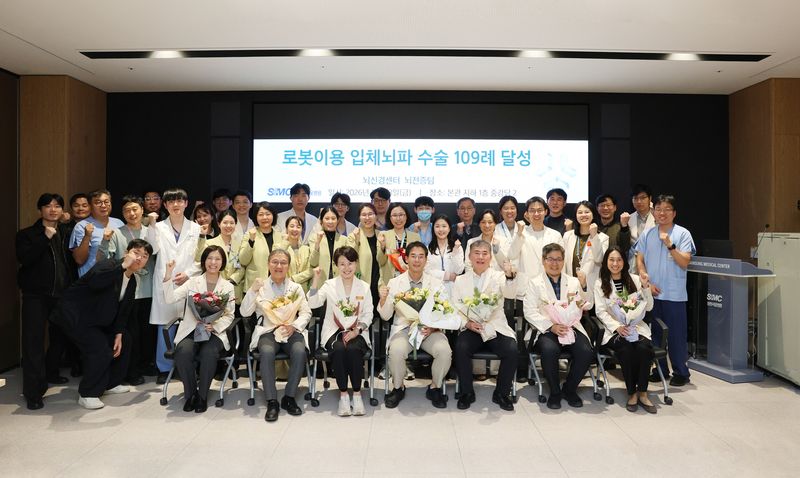
[Financial News] Surgery may be an option for drug-resistant epilepsy, in which seizures continue despite medication. The key is pinpointing where in the brain the seizures begin. Samsung Medical Center has performed 109 surgeries using a robot to locate that area.
Samsung Medical Center said it had completed 109 robot-assisted epilepsy surgeries and held a ceremony on the 13th. Seo Dae-won, director of the Neuroscience Center and a professor of neurology, said that day that the center had “provided patients with drug-resistant epilepsy that cannot be controlled with medication an opportunity for more precise and safer treatment.”
There are an estimated 500,000 people with epilepsy in Korea. About 30% of them are believed to have drug-resistant epilepsy, in which seizures recur despite medication. When surgery is needed to remove the part of the cerebrum where seizures occur, it is especially important to accurately identify the “seizure focus”—the area that triggers them.
In 2021, Samsung Medical Center became the first in Korea to introduce ROSA (Robotic Stereotactic Assistance), a robot for epilepsy surgery. ROSA assists with stereo-EEG electrode implantation, in which electrodes are placed in the brain to locate where seizures begin. Typically, 10–20 electrodes are inserted through the skull into target areas, allowing brain waves to be recorded directly from multiple regions of the cerebrum, both hemispheres and deep brain regions, and analyzed in 3D.
Once the electrode insertion paths have been planned using preoperative MRI and CT images, ROSA aligns and secures each path at the precise angle and position from the entry point in the skull to the target in the cerebrum. Because the doctor inserts the electrodes along the trajectory guided by the robot, they can be placed quickly and safely with millimeter-level precision, avoiding major blood vessels and important brain structures.
According to the hospital’s analysis, since ROSA was introduced, the time needed to place electrodes has fallen to about one-third, while accuracy has risen to 95% or higher. Complications from electrode insertion have also dropped to 1% or less.
Professor Lee Seung-hoon of neurosurgery, who performs the electrode implantation surgeries, explained that “the introduction of ROSA has lowered the risk of procedure-related complications such as brain hemorrhage and shortened overall surgery time, reducing the burden on patients.”
Samsung Medical Center has also developed and uses its own stereo-EEG electrode implantation system, SESTA (SMC epilepsy surgery trajectory application), based on digital twin technology that creates a virtual model of a patient’s brain. The approach improves the safety of actual surgery through simulations in which electrodes are first placed in the virtual brain.
Director Seo said the achievement was “thanks to the close collaboration of epilepsy specialists in neurology, pediatrics and neurosurgery, working as one team,” adding, “We will continue to work on developing more advanced treatments so we can wipe away the tears of people with epilepsy.”
Samsung Medical Center operates a multidisciplinary epilepsy surgery team comprising neurology professors Seo Dae-won, Son Young-min, Joo Eun-yeon and Park Hye-ri; pediatrics professors Lee Ji-hoon and Lee Ji-won; and neurosurgery professor Lee Seung-hoon.
[email protected] Jeong Myeong-jin, medical correspondent Reporter