A Treatment Clue Found for Gastric Cancer Cells That Cried 'Don't Eat Me' [Health Check]
- Input
- 2026-11-16 08:45:00
- Updated
- 2026-11-16 08:45:00
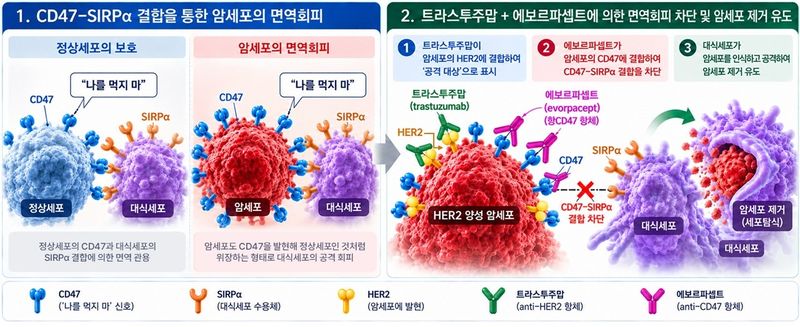
[Financial News] Cancer cells evade attacks by sending immune cells a “don’t eat me” signal. When a South Korean research team added a drug that blocks this signal to existing cancer treatment, the response rate among patients with HER2-positive metastatic gastric cancer rose substantially.
A team led by Professor Lee Geun-wook of the Department of Hematology and Medical Oncology at Seoul National University Bundang Hospital and Seoul National University College of Medicine said on the 16th that it had published clinical trial results in the international journal Nature Medicine showing that the drug evorpacept, which blocks cancer cells’ defensive signals, can enhance the effects of cancer treatment when used with targeted therapy. The trial involved 49 institutions in 10 countries.
The “don’t eat me” signal is a means that normal cells use to avoid attacks by immune cells. When the CD47 protein on the surface of a normal cell binds to SIRPα on a macrophage, an immune cell, it generates a signal that protects the normal cell. Some cancer cells exploit this mechanism by increasing their CD47 protein and evading attacks by macrophages.
The research team blocked this signal using evorpacept, a drug still in the clinical trial stage. Evorpacept blocks the binding of CD47 and SIRPα. The team also used trastuzumab, a targeted cancer drug that binds to HER2-positive cancer cells. The principle is that trastuzumab marks cancer cells as targets for attack, while evorpacept switches off the defensive signal, helping macrophages eliminate cancer cells effectively.
The clinical trial involved 127 patients with gastric cancer whose disease had progressed after HER2-targeted treatment. The research team randomly assigned the patients to either a combination group, which received trastuzumab and evorpacept in addition to existing cancer treatment (63 patients), or a control group, which received trastuzumab alone in addition to existing treatment (64 patients), and compared the results.
The objective response rate—the proportion of patients whose tumors shrank by at least a specified amount—was 40.3% in the combination group and 26.6% in the control group. The median duration of response was also 15.7 months in the combination group, more than twice the 7.6 months in the control group.
The research team also analyzed which patients were more likely to benefit from the combination treatment. Believing that the two drugs would be more effective in patients who remained HER2-positive after existing cancer treatment and whose cancer cells had high CD47 expression, the team separately examined 48 patients who met both conditions.
Among these patients, the objective response rate was 63.6% in the combination group (22 patients), far higher than the 23.1% in the control group (26 patients). The median duration of response was 25.5 months in the combination group and 8.4 months in the control group. The median progression-free survival—the time patients lived without their cancer progressing—also differed, at 19.5 months and 7.0 months, respectively.
By contrast, the combination treatment showed no clear additional benefit in patients who did not meet both conditions. This suggests that treatment outcomes can be improved by selecting patients whose cancer has targets for the drugs and giving them the combination treatment.
Corresponding author Professor Lee Geun-wook said, “This is significant because it points to the potential of a new cancer treatment strategy that supports the role of macrophages by using together targeted cancer drugs that identify cancer cells and drugs that block defensive signals.” He added, “If the treatment’s effectiveness is confirmed in large-scale clinical trials in the future, we expect it could develop into a precision immunotherapy for cancer.”
Professor Lee added, “We will continue to develop new cancer treatment strategies that combine CD47 blockers with antibodies that recognize not only HER2 but also other cancer targets.”
[email protected] Medical Correspondent Jung Myung-jin Reporter