"Drug Response Is in the Genes"... Some People Respond Better to GLP-1 Diabetes Drugs [Health Check]
- Input
- 2026-11-16 08:31:25
- Updated
- 2026-11-16 08:31:25
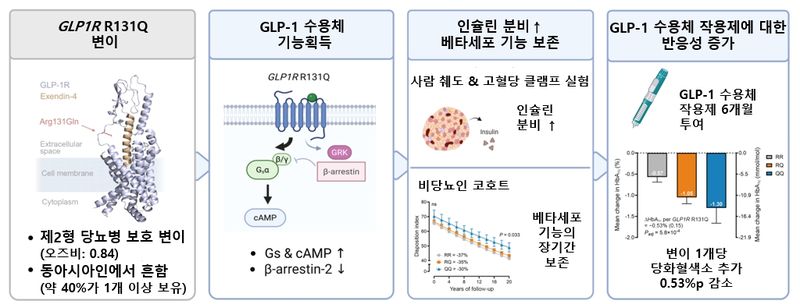
[Financial News] Why do some patients’ blood sugar levels fall more than others’ after receiving the same medication? A joint Korean and international research team has found a genetic clue that may explain the difference. The GLP1R R131Q variant, carried by four in 10 East Asians, was found to enhance the blood-sugar-lowering effects of GLP-1 diabetes medications and slow the decline in pancreatic beta-cell function.
A joint research team comprising Professor Kwak Soo Heon of the Division of Endocrinology and Metabolism at Seoul National University Hospital (SNUH), Professor Kim Jong-il of the Institute of Genomic Medicine at Seoul National University College of Medicine (with Dr. Lee Hyun-seok as first author), Professor Park Kyung-soo of the Division of Endocrinology and Metabolism at Konkuk University Medical Center, and the Mayo Clinic in the United States announced on the 16th its findings on the effects of this variant (rs3765467). The researchers analyzed clinical data from patients, a long-term follow-up cohort, hyperglycemic clamp tests, and experiments involving cells and human pancreatic islets. The findings were published in the latest online edition of Diabetes Care, the American Diabetes Association’s (ADA) official journal (impact factor: 22.6).
GLP-1 medications are used to control blood sugar and reduce weight, but patients respond differently, creating a need for indicators that can predict treatment outcomes. The variant analyzed in this study is common among East Asians but rare among Europeans, where its allele frequency is below 0.3%. It was known to lower the risk of type 2 diabetes (odds ratio: 0.84), but its mechanism and effects on drug response had not been established.
The research team first analyzed 177 patients with type 2 diabetes who had received GLP-1 medications for at least six months at Seoul National University Hospital (SNUH), Seoul National University Bundang Hospital, SMG-SNU Boramae Medical Center, and Gachon University Gil Medical Center. Of the patients, 119 had no copies of the variant, 51 had one, and seven had two. About 80% of those analyzed had received dulaglutide.
The reduction in glycated hemoglobin (HbA1c) was, on average, 0.53 percentage points greater for each copy of the variant. HbA1c is an indicator of average blood sugar levels over the preceding several months. HbA1c fell by an average of 0.57 percentage points in the group with no copies of the variant, compared with 1.05 percentage points in the group with one copy and 1.30 percentage points in the group with two. The share of patients whose HbA1c reached 7% or lower after six months of treatment also rose with the number of copies: 8.4% in the group with none, 22% in the group with one, and 43% in the group with two. However, weight loss did not differ by genotype.
The variant was also associated with long-term changes in pancreatic beta-cell function. In a 20-year follow-up of 6,373 people without diabetes in the Ansan-si and Anseong cohorts of the Korean Genome and Epidemiology Study, the disposition index, a measure of beta-cell function, declined from baseline by 37% in those with no copies of the variant, 35% in those with one, and 30% in those with two. The disposition index reflects both insulin secretion and insulin sensitivity. In other words, the more copies people had, the less their function declined over 20 years.
Cell experiments confirmed the mechanism. When stimulated by medication, the variant form of the GLP-1 receptor produced more cAMP, a signal involved in insulin secretion, while its binding to beta-arrestin-2, which desensitizes the receptor, was reduced. The variant receptor’s maximum cAMP response was 1.43 times that of the normal form when stimulated by GLP-1 and 1.28 times when stimulated by semaglutide, the active ingredient in Wegovy. The researchers considered the findings consistent with “biased signaling,” in which a particular signaling pathway is relatively enhanced, and classified the variant as a gain-of-function variant.
Experiments involving people produced results in the same direction. In a hyperglycemic clamp test conducted at the Mayo Clinic in 17 people without diabetes, insulin secretion after liraglutide administration tended to increase more among variant carriers (P=0.050). In an experiment analyzing pancreatic islets from 21 people without diabetes who underwent surgery at Seoul National University Hospital (SNUH), the increase in insulin secretion after stimulation with exendin-4 was greater among those with more copies of the variant (P=0.037).
Professor Kwak Soo Heon said, “We have established a basis for using genetic information to explain why blood sugar levels fall differently in different patients, even when they receive the same medication.” He added, “This will also help us understand why the medication has been thought to work better in East Asians.”
Professor Park Kyung-soo said, “We have confirmed through multiple lines of evidence that a genetic variant common among East Asians is associated with both the preservation of pancreatic function and response to GLP-1 medications.” He added, “Because these findings come from an observational study, we will pursue further validation, including randomized clinical trials, and develop them into an evidence base for precision diabetes treatment tailored to East Asians.”

[email protected] Jung Myung-jin, Medical Correspondent Reporter