Rail Accidents Decline, but Similar Incidents Keep Recurring... MOLIT to Prepare Comprehensive Measures This Year
- Input
- 2026-11-16 14:00:00
- Updated
- 2026-11-16 14:00:02
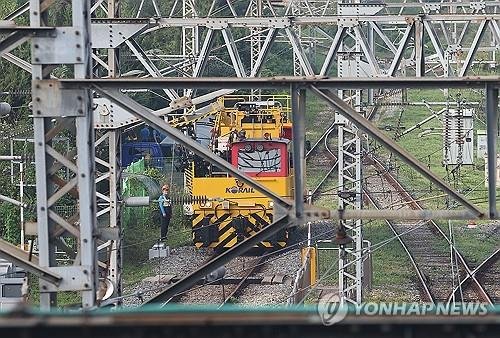
[Financial News] MOLIT brought together relevant agencies and experts to prevent railway accidents and service disruptions that, although declining year after year, continue to recur in similar forms.
According to MOLIT on the 16th, the fourth Rail Safety Meeting was held that day at the Government Complex Sejong. Attendees included the Korea Railroad Corporation (Korail), Korea National Railway, Korea Railroad Research Institute (KRRI), Korea Transportation Safety Authority and private-sector experts. The number of railway accidents fell from 82 in 2022 to 68 in 2023, 46 in 2024 and 42 last year, roughly halving over three years. There were 25 accidents through October this year. While MOLIT considers its measures and on-site inspections to date effective, it took a close look at whether the measures are working in practice, given that similar accidents continue to occur.
On the track side, a derailment at Busan Station prompted action. Wooden sleepers in high-risk sections at 24 stations with heavy train traffic were inspected and reinforced as a priority, and 125 devices to prevent track gauge widening were newly installed. Wooden sleepers are timber supports laid crosswise under the rails to hold them in place and distribute the weight of trains. All 1,609,000 wooden sleepers nationwide will be inspected by the end of the year, and about 16,000 of the older ones will be replaced with new sleepers this year.
In the rolling stock sector, inspections were completed on 11 trainsets equipped with the same device involved in a KTX power transmission system failure. To prevent KTX-Sancheon trains from suddenly making emergency stops, the replacement interval for a related electrical component, the multiple-unit relay, was shortened from 15 years to five. Ten switches that detect air pressure in the braking system were also replaced in advance. Going forward, worn parts in braking systems and electrical control systems will be replaced, and maintenance procedures will also be revised.
Procedures were refined for accidents during train operations. To prevent freight train derailments and passenger trains from passing stations where they are supposed to stop, operating procedures for stopping and starting trains were revised, and special safety inspections were conducted at crew depots. If a stationary train begins moving unintentionally—a train rollaway—it must be reported to train control immediately, and the safety of nearby tracks must be checked first. Train operators at 51 crew depots received special safety training. At Seoul Station, lubrication was completed on key operating components at 67 locations to prevent track switch failures, and all switches of the same type as the one that failed will be inspected by the end of this month.
The meeting also reviewed implementation of safety measures for rolling stock marshalling (shunting). The measures were announced on September 29, just over a month after a Korail employee died while carrying out shunting work at Uiwang Station in Gyeonggi Province. Shunting involves coupling, uncoupling or moving rail vehicles. It is carried out about 1,370 times a day on average across 115 stations nationwide, and in 41.4% of cases workers have to climb aboard the vehicles. Over the past 10 years, the work has been linked to three fatal accidents and seven accidents causing injuries.
Korail completed development of rear-view camera technology this month to change the practice of workers traveling while hanging off the outside of freight cars. The stations where it will be introduced will be selected after on-site testing. A radio-controlled shunting system, which allows workers to remotely operate vehicles using wireless devices without a driver, is in operation at three stations: Yeongju, Goedong and Jecheon Marshalling Yard (up line). The plan is to expand the system by 2027 to Jecheon Marshalling Yard (down line), Susaek, Dodam, Daejeon Marshalling Yard, Donghae and Obong, bringing the total to eight stations, and to pursue its introduction at Uiwang Station in 2028. A system that uses artificial intelligence (AI) and closed-circuit television (CCTV) to predict risks to workers in advance will be piloted at Donghae Station in 2027.
The work environment will also be improved. Harmful and hazardous factors obstructing passageways and visibility have been removed at 20 locations across three stations, and lighting facilities at 100 or more locations will be improved by 2028 to make night work safer. The ministry plans to institutionalize regular on-site inspections by managers and embed the measures in day-to-day operations through frequent inspections by safety management specialists and awards for exemplary improvements. MOLIT will continue to monitor the improvements confirmed this time and the areas needing further work, and plans to announce additional measures based on input from relevant agencies and experts.
Kim Tae-byeong, director of MOLIT’s Rail Bureau, said, “The recurrence of similar accidents despite our efforts to implement various rail safety measures means that we need to fundamentally review how existing measures are being implemented on the ground and the safety management system. We will work with relevant agencies to draw up a comprehensive plan to strengthen rail safety by the end of this year, improving the effectiveness of accident prevention by strengthening the management of rail vehicles and facilities and minimizing human error through the use of advanced technologies.”
[email protected] Jeong Gyeong-su Reporter