‘Level 7 in Math’ YouTuber Solves CSAT Questions Wearing AI Glasses... ‘The Results Are Shocking’
- Input
- 2026-11-16 08:01:56
- Updated
- 2026-11-16 08:06:14
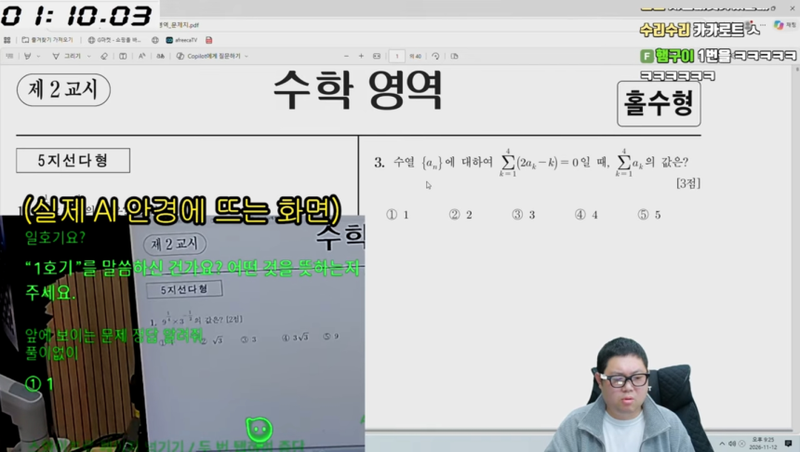
[Financial News] A YouTuber known as Gamst (real name: Kim In-jik) said he got five of the 30 questions wrong after using AI-powered smart glasses to solve math problems from last year’s College Scholastic Ability Test (CSAT). He said he had been a “Level 7 in math” in high school and solved all the questions in about 50 minutes—half the allotted test time—while wearing the AI glasses.
On the 13th, Gamst posted a video on his YouTube channel titled “Controversial AI Glasses: I Tried the CSAT Math Test, and the Results Are Shocking.”
In the video, ahead of the CSAT scheduled for the 19th, he wore AI glasses that had raised concerns about cheating and demonstrated solving math questions from the 2026 academic year’s CSAT.
The AI glasses Gamst wore that day were worth about 900,000 won and looked almost no different from ordinary glasses.
In particular, Gamst, whose high school math grades were around Levels 6 and 7, drew attention by solving in just 50 minutes the CSAT math test, which requires test takers to answer 30 questions in 100 minutes.
The results were also surprising: he got only five questions wrong. Gamst used a system in which the AI provided answers when he photographed the questions with the glasses. “I set the screen to show only the answers, without any solutions,” he said, explaining, “It usually solves them all in about five seconds, except for the written-response questions.”
He stressed, “If even someone like me, who knows nothing about math, gets only five questions wrong, that’s a serious problem,” adding, “Whatever happens, we have to root it out and catch those responsible.” He went on to criticize those who might have passed after using the glasses illegally, saying, “If anyone passed by using them illegally, they should feel guilty.”
For the 2027 academic year’s CSAT, bringing electronic devices such as mobile phones and smartwatches is prohibited. The problem is that there is no system in place to technically check every test taker’s belongings and wearable equipment at the exam sites.
Education authorities have repeatedly said they would address the possibility of cheating with AI smart glasses by assigning dedicated staff to every CSAT test site to deal with new devices such as AI glasses and by strengthening proctor training, among other measures.
However, concerns have been raised that it is difficult to detect cheating with tiny cameras or communications equipment that are small in appearance by relying solely on proctors’ visual checks of test takers’ behavior and belongings.
[email protected] Ahn Ga-eul Reporter