Four of Five Fully Charged Batteries Ignite in Pressure Test; Seoul Moves to Set Storage Safety Standards
- Input
- 2026-11-16 06:00:00
- Updated
- 2026-11-16 06:00:06
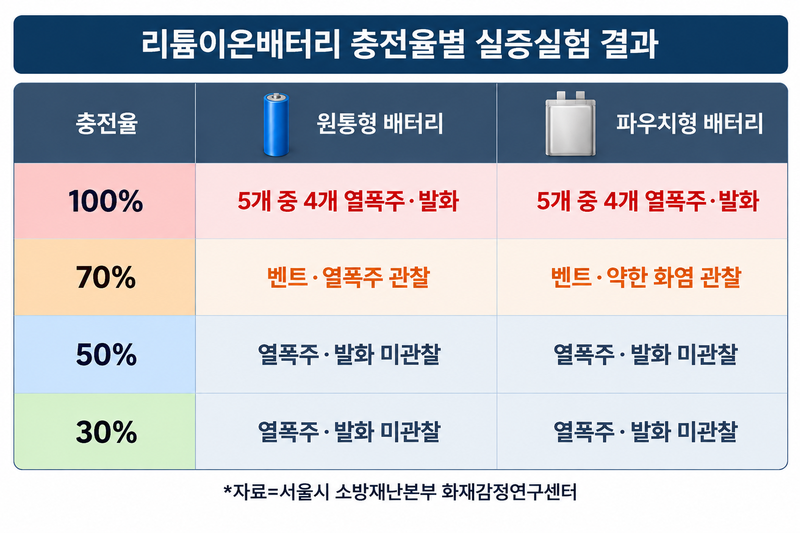
[Financial News] The higher the charge level of a lithium-ion battery, the greater the risk of fire from external pressure, the results showed. Based on these findings, the Seoul Metropolitan Government plans to work with the National Fire Agency to establish safety standards, including charge-level controls during battery distribution and storage.
On the 16th, the Seoul Metropolitan Government released the results of an experiment by the Fire Investigation Research Center of the Seoul Metropolitan Fire and Disaster Headquarters on fire risks at different charge levels for lithium-ion batteries. The experiment was conducted following a fire at an Incheon logistics center last July to determine whether charge levels should be managed during battery distribution and storage.
The experiment tested two types of batteries sold commercially: cylindrical lithium-ion batteries and pouch-type lithium-ion polymer batteries. Each was set to charge levels of 30%, 50%, 70% and 100%, and a pneumatic press applied a set pressure to the center of the battery. Five tests were conducted for each battery type at each charge level, comparing temperature changes, internal gas release, and whether thermal runaway or ignition occurred.
At a 100% charge level, thermal runaway and ignition occurred in four out of five batteries of each type. Thermal runaway and flames were also observed at 70%. The cylindrical batteries released internal gas and experienced thermal runaway, while the pouch-type batteries released gas and produced weak flames. By contrast, neither thermal runaway nor ignition was observed in either type at charge levels of 30% and 50%.
However, the Seoul Metropolitan Government said it would be difficult to conclude that there is no fire risk at charge levels of 50% or less, since the experiment involved only some batteries and was conducted under specific pressure conditions. Fire risks may vary depending on factors such as battery type and external impact, it said.
These findings are also in line with the government’s efforts to strengthen battery safety management following the Incheon logistics center fire. In October, the National Fire Agency estimated that the fire at the center was caused by thermal runaway in lithium-ion batteries and raised the need to limit the charge levels of batteries stored in logistics warehouses to a certain level or below. The Ministry of Land, Infrastructure and Transport has also begun work to improve fire-safety regulations for logistics facilities. However, specific upper charge limits and which batteries they would apply to have not yet been decided.
The Seoul Metropolitan Government said that, because there are currently no separate standards limiting charge levels during battery distribution and storage, products charged to around 80% to 90% are being loaded at logistics facilities alongside ordinary goods. By contrast, in air transport, a limit of 30% or less applies to lithium-ion batteries in some forms of transport to reduce fire risks.
The Seoul Metropolitan Fire and Disaster Headquarters and the National Fire Agency plan to consult with relevant ministries on establishing safety standards, including charge-level controls during battery distribution and storage, based on the experiment’s findings. They believe a management system that takes into account factors such as loading conditions at logistics facilities and battery charge levels is needed.
Hong Young-geun, head of the Seoul Metropolitan Fire and Disaster Headquarters, said, “This experiment confirmed that a battery’s charge level can affect fire risk.” He added, “We will continue to identify fire risk factors through scientific experiments and analysis, and build up the evidence needed to establish effective safety management standards for the distribution and storage of batteries.”
[email protected] Seong Cho-rong Reporter