"Trying to Give the Kid a Room Could Wreck the Family Budget" ... Moving From 24 to 34 Pyeong: The "400 Million Won Wall" [House Signal]
- Input
- 2026-11-15 19:00:00
- Updated
- 2026-11-15 19:00:05

[Financial News] Next year, a seven-year-old child will start elementary school.
The time has come to clear away the toy boxes taking up a corner of the living room and set up a proper desk. It is every parent’s natural wish to give a child who has shared a blanket with them at night a bed where they can fall asleep alone and a room entirely their own.
But the barriers of reality begin with the layout of the home. It is an apartment with 59m2 of exclusive floor area (about 24 pyeong), bought by maxing out their borrowing when they were newlyweds. In the two-bedroom layout, the couple use the main bedroom, while the one remaining small room has long been taken over by a closet and assorted clutter. They even bring out a tape measure to try to make room for the child’s desk and bed, but there is simply no way to make it work.
In the end, the couple make a decision. “The child is growing, so it’s time to move up to 34 pyeong, the so-called national standard size.” To avoid separating the child from the neighborhood friends they worked hard to make, and to keep them from feeling overwhelmed in an unfamiliar environment, they search listings for 84m2 apartments (about 34 pyeong) in the same complex or nearby. The numbers on the real estate app make their hearts sink.
■ From 24 to 34 Pyeong ... The “400 Million Won” Cost of Adding One Room
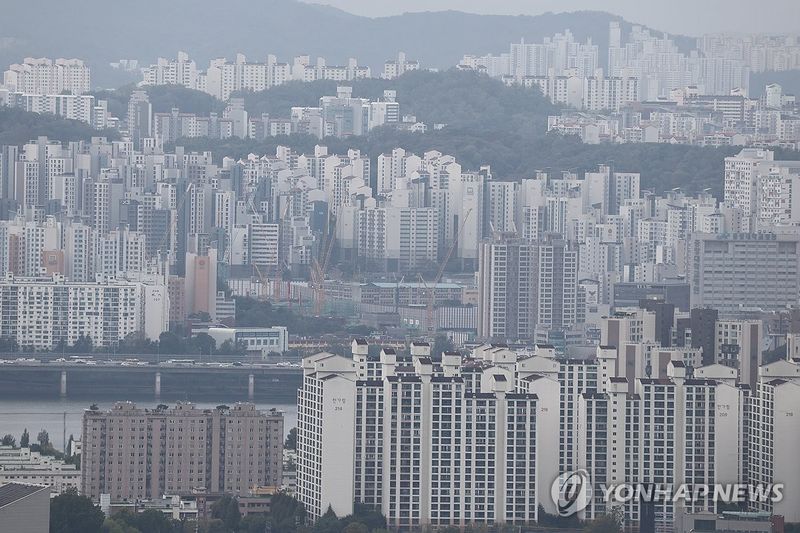
The statistics show in clear numbers the barrier ordinary families face when moving to a larger home. In major apartment complexes across Seoul, the sale-price gap between 59m2 and 84m2 units typically ranges from 300 million to around 400 million won.
Various housing statistics, including those from KB Real Estate, show that the average sale-price gap between apartment sizes in Seoul keeps widening year after year. The premium for moving from a small-to-medium unit (59m2) to a medium-sized one (84m2) is especially steep in so-called “desirable neighborhoods,” where school districts are reasonably well established or transportation is convenient.
Suppose they manage to sell their current 24-pyeong apartment for a fair price and put in every bit of the money they have saved by cutting living expenses. They would still need another 300 million to 400 million won, at a minimum, to cross the threshold into a 34-pyeong apartment. That is an enormous price to pay just to give their child one more room.
■ 1.5 Million Won in Interest Vanishing Every Month ... The “Numbers” Hitting the Household Budget
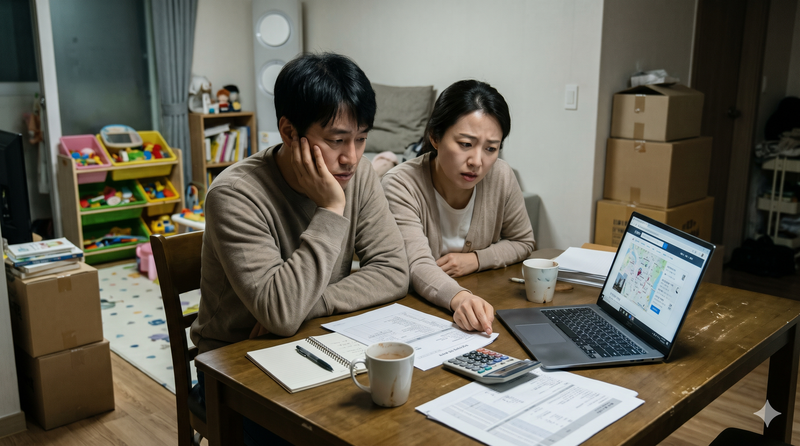
What would happen to the household budget if the shortfall of 400 million won had to be covered entirely with a mortgage?
If they borrow 400 million won at an annual interest rate of 4.5%, the interest alone would amount to 18 million won a year. Setting principal repayment aside, the interest alone due to the bank each month would reach 1.5 million won. If they chose a 30-year repayment plan with equal monthly payments of principal and interest, the monthly payment would jump to about 2.02 million won.
Between 1.5 million and 2 million won a month. This figure does not simply mean one more expense item in the household budget. If an additional 2 million won were taken out of the salaries of a dual-income couple in their 30s or 40s, the family would have to reorganize its entire daily life.
The child’s private education costs, which will begin in earnest next year, would take a direct hit. They would have to put everything on the calculator—from English lessons and taekwondo to soccer classes, which the child loves and has recently become keen on—and weigh what to give up. At the supermarket, they would have to look twice at the price of a pack of meat, while weekend outings and the couple’s personal spending would be first on the chopping block.
■ When Did an “Ordinary 34-Pyeong Home” Become a Luxury?

Moving to a larger home is a natural part of the life cycle as children grow. When a child starts elementary school and gets bigger, the family needs enough physical space to live without constantly getting in one another’s way.
But Seoul’s real estate market today does not allow for this utterly ordinary, natural stage of growth. Once the rosy vision of rising asset values is stripped away, all that remains is the harsh reality of having to endure a cash crunch of several million won every month.
Late tonight, as they watch their child from behind, lying on the living-room floor and drawing in a sketchbook, the parents wrestle with a choice: Should they take on an excessive loan, move to a bigger home and make the family’s daily life financially strained, or stay in a cramped home and preserve the freedom they have now to go out for a good meal with their child on weekends, even if they have to squeeze together?
The reality is that they cannot readily nod in agreement when their child says, “I want my own room when I start elementary school.”
An ordinary 34-pyeong apartment sized for the number of family members has become a crushing bill that leaves an ordinary salaried couple struggling to breathe.
[email protected] Jeon Sang-il Reporter