Loans to Cover Jeonse Deposits Surge 53%... Tenants Could Face an Even Greater Burden
- Input
- 2026-11-15 15:15:34
- Updated
- 2026-11-15 15:15:34
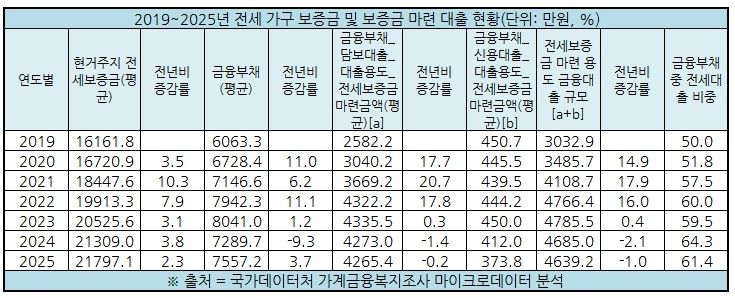
According to the National Data Agency’s Survey of Household Finances and Living Conditions, released on the 15th, the average deposit for households living under jeonse arrangements was 217.97 million won in 2025, up 34.9% from 161.62 million won in 2019.
Over the same period, the average amount of financial debt taken on by jeonse households to cover their deposits also rose sharply. The amount was 30.33 million won in 2019, but surged 53% to 46.39 million won in 2025. Financial debt is the combined amount of loans secured by collateral and unsecured credit loans. The increase was at least 18 percentage points higher than the rise in deposits.
However, from 2023 onward, growth in debt taken on to cover deposits slowed to the 1%–2% range. From 2020 through 2022, it grew in the 10% range each year.
As interest costs on jeonse loans rose during the period of interest rate hikes, demand for borrowing contracted, and there may have been a shift from jeonse to monthly rent or semi-jeonse.
With jeonse and monthly rental prices rising this year and deposit loans also increasing substantially, tenants’ burden is expected to grow. According to the KB Financial Group Management Research Institute, nationwide housing jeonse prices rose 0.32% in September from the previous month, a faster increase than the 0.30% rise in August. Prices rose 0.64% in Seoul and 0.59% in Gyeonggi.
Interest rates on jeonse loans are also rising. According to the Bank of Korea’s Monetary and Financial Statistics, the rate on jeonse loans issued by deposit-taking banks, based on newly extended loans, fell to an annual 3.70% in May last year, then rose to 4.57% in September this year.
[email protected] Kwon Jun-ho Reporter