Trump Wants Nuclear Arms Control, Putin an End to the War, Xi Sees a Burden... U.S.-China-Russia Summit: Three Different Dreams
- Input
- 2026-11-15 16:13:33
- Updated
- 2026-11-15 16:21:24
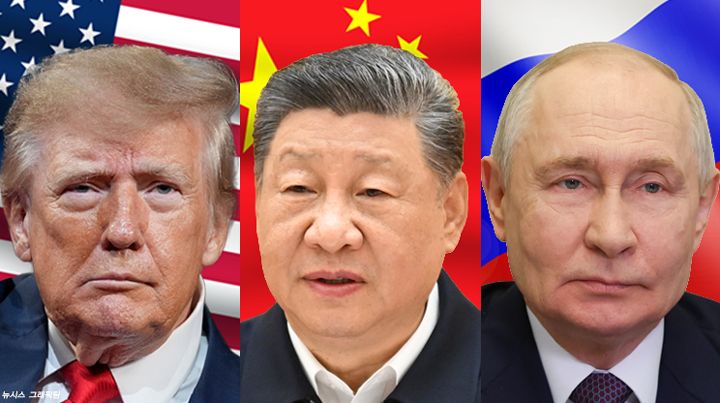
On the 14th (local time), Kremlin spokesman Dmitry Peskov announced that “an agreement has been reached to hold a trilateral meeting on the 19th between Russian President Vladimir Putin, Chinese President Xi Jinping and U.S. President Donald Trump.” In this regard, White House spokeswoman Olivia Wales had earlier said on the 13th that “President Trump is scheduled to meet with President Xi and President Putin on the last day of his visit to China.”
U.S.-China-Russia summit: three countries, three different dreams?
The summit’s agenda and format have yet to be finalized, and the three leaders are said to have differing interests. For example, Putin is hoping for an agreement to end the war in Ukraine on terms favorable to Russia. Trump, meanwhile, was dealt a political blow at home after the Republican Party suffered a crushing defeat in the recent midterm elections, and may seek progress toward a three-way agreement on nuclear arms control to make the summit a diplomatic success.For Xi, by contrast, the summit is a high-risk and uncertain undertaking, since discussions on nuclear arms control—which Trump is hoping for—are far removed from China’s position. The United States and Russia each possess at least 5,000 nuclear warheads, while China has only about 500. China is reportedly reluctant to take on arms-control obligations on the same level as the other two countries.
Fears of “Another Yalta”
Meanwhile, Ukraine and others unable to take part in the summit fear that the great powers could make secret deals over their fate. Last month, Ukrainian President Volodymyr Zelenskyy said, in connection with plans for the trilateral summit, “I really don’t want it to become a ‘second, third or fourth Yalta’ that redistributes influence.” The Yalta Conference was a meeting in February 1945 at which the leaders of the United States, the United Kingdom and the Soviet Union gathered to discuss the postwar order in Europe and other arrangements following the end of World War II. It symbolizes the power politics in which the fate of smaller countries is often decided through negotiations among great powers without their participation.Discussions that exclude Ukraine are also a burden for China, a party to the summit. China, which was not invited to the 1945 Yalta Conference, now promotes an image of itself as a country that represents the interests of relatively small nations.
According to sources briefed on the actual summit plans and European diplomats, Russia wanted to discuss the war in Ukraine, but China was reportedly reluctant to include the issue on the agenda. A U.S. official also reportedly said that President Trump was unlikely to bring up the war in Ukraine and that the trilateral summit was not an appropriate venue to discuss it.
Concerns that their national interests could be pushed aside in negotiations among great powers have also emerged in South Korea and Japan. On the 13th, the New York Post, citing a White House official, reported that “the North Korea issue could also be discussed.” The following day, the Japanese news agency Kyodo News, citing a diplomatic source, said that “it would be a threat to Japan if the three countries acted like leaders of the international community.”
[email protected] Hong Chae-wan Reporter