Residents to Participate in Selecting Town, Township and Neighborhood Chiefs Starting Next Year
- Input
- 2026-11-15 13:15:00
- Updated
- 2026-11-15 13:15:00
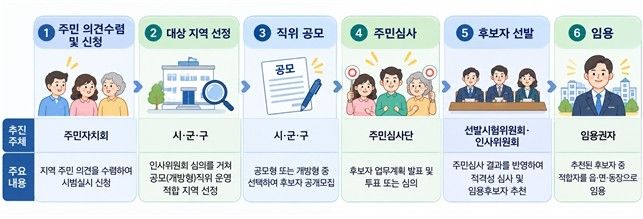
[Financial News] Starting next year, residents’ assessments will be reflected in appointment reviews when town, township and neighborhood chiefs are selected. Residents will assess candidates’ job capabilities and express their views through voting or deliberation. People with private-sector experience, as well as civil servants, will be able to apply for the positions.
MOIS announced on the 15th that it had drawn up a basic plan for a pilot of the ‘Resident-Choice Appointment System for Town, Township and Neighborhood Chiefs.’ The pilot is generally set to begin with regular personnel appointments in July next year, but the start date may vary depending on local government circumstances.
This is not the first time residents have taken part in selecting town, township and neighborhood chiefs. Similar systems have been in place since 2014 in 78 towns, townships and neighborhoods across 20 local governments nationwide. However, amid debate over resident representation, difficulties in vetting candidates and low participation, the system is now operating in only four locations, as of September this year: Seokgyo-dong and Yongdu-dong in Jung District, Daejeon; Godeok-myeon in Pyeongtaek, Gyeonggi Province; and Gwangmyeong 6-dong in Gwangmyeong-si.
The government has decided to revise the composition of resident review panels and the candidate vetting process to expand the system again. If a resident self-governing council gathers residents’ views and applies to the relevant city, county or district, the local government will choose whether to implement the application-based or open model.
The application-based model is open to Grade 5 civil servants and those approved for promotion to Grade 5. Under the open model, private-sector applicants with experience in fields such as community building, social welfare and business management will also be eligible, alongside civil servants. The term is two years, with one opportunity for reappointment.
Resident reviews are divided into voting and deliberation models. For the voting model, residents aged 18 or older are recruited publicly, and panelists are selected at random with consideration given to age, gender, occupation and neighborhood, among other factors. At least 100 to 500 people will participate. After candidates present their work plans and answer questions, the panel votes by secret ballot. In the deliberation model, at least 20 people—including resident self-governing council members and representatives of local institutions and civic groups—assess candidates’ expertise, organizational management skills and plans for communicating with residents.
However, a vote by residents does not directly determine who becomes a town, township or neighborhood chief. Residents’ assessments are factored into the eligibility review by the selection examination committee, after which the appointment process, including review by a personnel committee, takes place.
MOIS plans to award bonus points in its local government innovation evaluation to local governments participating in the pilot, and to commend high-performing local governments. It will also analyze the results and develop a standard operating model.
Minister of the Interior and Safety Yun Ho-jung said, “The pilot of the ‘Resident-Choice Appointment System for Town, Township and Neighborhood Chiefs’ is an effort to take resident self-governance to a higher level, as it involves residents in directly choosing the town, township and neighborhood chiefs responsible for day-to-day local administration.” He added, “We will actively support the realization of substantive resident self-governance by ensuring that residents’ choices and voices are reflected in local administration through this pilot.”
[email protected] Lee Bomi Reporter