'SK: A Virtuous Business Cycle From Semiconductors to AI Services'... Chey Tae-won Presents 'AI Flywheel'
- Input
- 2026-11-15 12:00:06
- Updated
- 2026-11-15 12:00:06
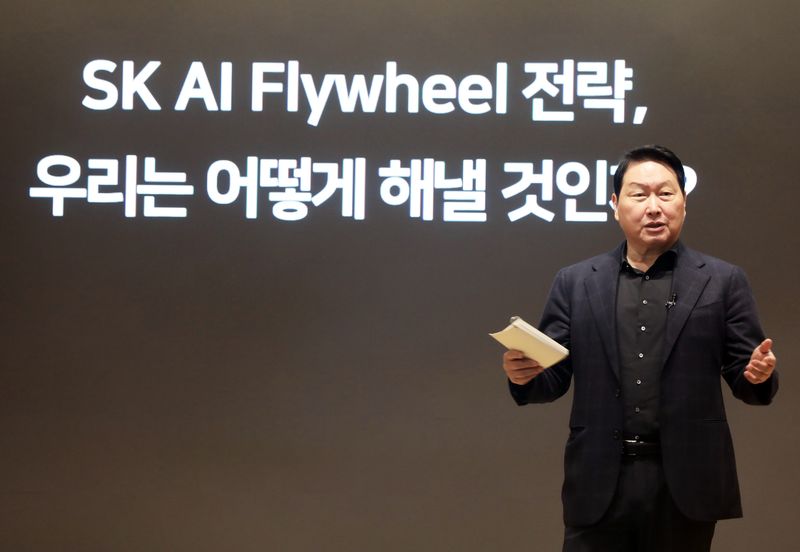
[Financial News] Chey Tae-won, chairman of SK Group, unveiled a plan to expand the AI business it has built around AI semiconductors and data centers into service areas such as AI models and applications (apps).
The plan is to build an “AI flywheel” in which SK expands AI computing infrastructure on the strength of its semiconductor competitiveness, and services built on that infrastructure in turn drive demand for computing and semiconductors. The strategy is seen as an effort by SK, which has participated in investment in AI infrastructure, to secure revenue streams as actual AI usage grows.
■ A virtuous cycle across all businesses, starting with AI semiconductors
SK Group said on the 15th that it held the 2026 CEO Seminar at the SKMS Research Center in Icheon, Gyeonggi Province, from the 12th to the 14th, with some 50 people in attendance, including Chairman Chey Tae-won, Senior Vice Chairman Chey Jae-won, SK Supex Council Chairman Chey Chang-won, and the top executives of major member companies. They discussed a future growth strategy along these lines.At the seminar, Chey said, “We must break out of the framework of our existing businesses and redefine ourselves as an ‘AI company.’” He urged, “Let every member company find a new role among opportunities beyond existing domains that we have yet to discover, and build an ‘AI flywheel’ structure that connects all the way to AI services and the token economy.”
The starting point of the “AI flywheel” Chey emphasized is AI semiconductors. The idea is that a virtuous cycle can take shape: “AI semiconductor competitiveness → stronger AI factory business through large-scale AI computing facilities → expanded power supply and AI services businesses → increased demand for semiconductors.”
Like a flywheel, in which growth in one area leads to growth in another, the plan is to link the semiconductor, infrastructure and energy businesses built up so far to capture demand for services, then channel that demand back into growth in core businesses.
By referring to a “token economy” based on “tokens”—the units generative AI models use to process sentences and other inputs—Chey appears to have proposed linking chip sales and infrastructure supply to revenue tied to customers’ AI usage.
Chey therefore called on every affiliate to find opportunities in its respective business to connect with AI services. He said, “In the AI era, no one can do everything alone,” adding, “It is essential to enhance capabilities and speed through open collaboration with global partners.”
■ Strengthening the fundamentals to make the AI flywheel a reality
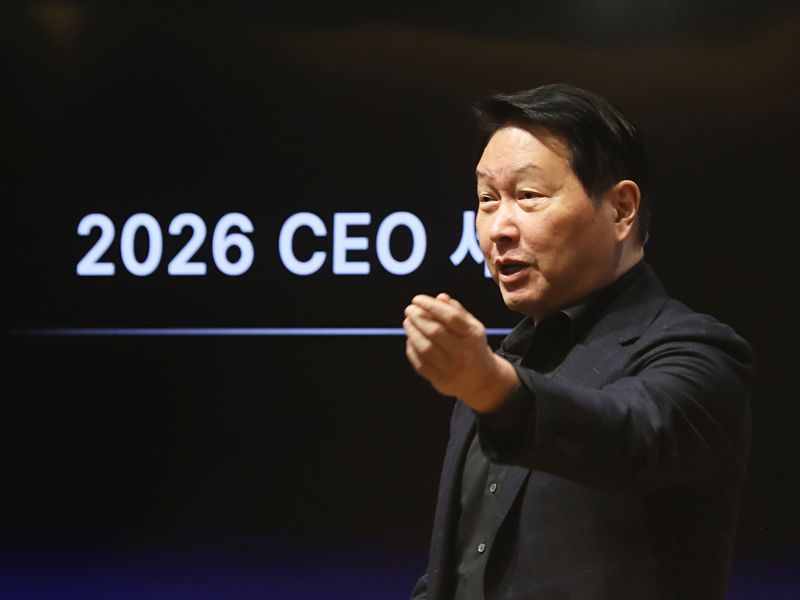
On the final day of the seminar, the 14th, Chey delivered a keynote address and then discussed business-specific opportunities and risks with executives from each affiliate.As they discussed how much AI could reduce costs in existing businesses and how to monetize the technologies and data accumulated in the process, Chey and SK executives also fleshed out ways to strengthen the fundamentals needed to support the “AI flywheel.”
Although semiconductors, data centers and power infrastructure require large investments, the timing of revenue from AI services depends on how quickly customers are acquired. For that reason, SK decided to continue “Portfolio Rebalancing 2.0,” streamlining inefficient businesses and strengthening the fundamentals of its core businesses. It also decided to balance financial soundness with future investment by allocating capital based on cash-generating capacity.
SK also decided to expand “practical AX (AI transformation),” applying AI to existing businesses to boost productivity and profitability, and drive innovation in revenue generation and ways of working.
Among the major examples of innovation, SK hynix is improving production efficiency by advancing its “smart fabs,” which combine AI and digital twins. SK Innovation improved yields at Ulsan CLX using a “process map (ontology)” that links equipment and operational data. SK Telecom Co., Ltd. (SKT) is raising productivity and improving the customer experience by automating AI-based network operations and service tasks. SK Gas is also credited with speeding up decision-making by using AI to analyze market conditions and turn business knowledge into an asset.
An SK representative said, “This CEO Seminar was an opportunity to look back on the business transformation efforts to date and review each member company’s role and tasks for execution under the ‘AI flywheel’ strategy.” The representative added, “We will continue to build our fundamental competitiveness and strengthen our execution capabilities based on frontline operations.”
[email protected] Kim Hak-jae, Park So-hyeon Reporter