"Son, This Is How You Should Invest in Stocks"... When People in Their 40s Bought, Those in Their 60s Sold
- Input
- 2026-11-15 14:39:02
- Updated
- 2026-11-15 14:39:02
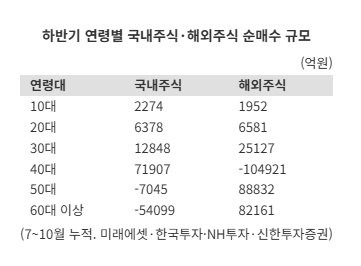
[Financial News] As stock market volatility increased in the second half, clear differences emerged in investment patterns across age groups. Amid a market correction, people in their 40s actively bought domestic stocks, while those aged 60 and over appeared to turn to foreign stocks. This is thought to reflect differences in investment goals, such as growing wealth and managing assets steadily, across age groups.■ Net purchases of 10 trillion won in foreign stocks... three times the amount in domestic stocksAccording to investment data Financial News received on the 14th from Mirae Asset Financial Group, Korea Investment Holdings, NH Investment & Securities, and Shinhan Investment & Securities, individual clients of the four securities firms made net purchases totaling 3.2262 trillion won in domestic stocks from July to October. Net purchases of foreign stocks totaled 9.9732 trillion won, about 3.1 times the amount in domestic stocks.
As the market correction began in earnest, individual investors made net purchases of 4.8971 trillion won and 2.4238 trillion won in domestic stocks in July and August, respectively. But in September, when the market recovered to the 7,000 level, they sold stocks worth 7.6561 trillion won. Then, last month, after the 6,000 level was breached, they bought 3.5613 trillion won worth of stocks.
Last month, in particular, every age group except those aged 60 and over bought domestic stocks. People in their 40s made net purchases of 2.3557 trillion won, those in their 50s bought 753.5 billion won, those in their 30s bought 523.1 billion won, and those in their 20s bought 215.6 billion won. Those aged 60 and over, however, made net sales of 348.8 billion won.
A private banker (PB) at a securities firm explained, "With the rise in the domestic stock market in the first half, some clients had become overly weighted toward semiconductor stocks such as Samsung Electronics and SK hynix." The PB added, "Some investors, including high-net-worth individuals, began taking profits and reducing their positions even before the market correction began in earnest."■ Clear differences in strategies by age... those in their 40s take an 'aggressive' approach, while those 60 and older favor 'stability'People in their 40s and those aged 60 and over showed clearly different trading patterns. From July to October, people in their 40s made net purchases of 7.1907 trillion won in domestic stocks, while those aged 60 and over made net sales of 5.4099 trillion won.
The difference became pronounced from July, when market volatility began to increase. Individual investors made net purchases of 4.8971 trillion won in domestic stocks that month, with people in their 40s leading the buying by snapping up 5.5674 trillion won worth. By contrast, those aged 60 and over made net sales of 1.6906 trillion won and began selling off their domestic stocks.
Trading patterns among people in their 40s and those aged 60 and over also differed in foreign stocks. From July to October, people in their 40s made net sales of 10.4921 trillion won in foreign stocks, while those aged 60 and over made net purchases of 8.2161 trillion won. However, the net selling of foreign stocks by people in their 40s was concentrated in July (-14.9303 trillion won).
The difference is thought to reflect the influence of investment goals at different stages of life. Unlike people in their 40s, who are active in growing their wealth, those aged 60 and over, who are nearing retirement or have already retired, tend to focus more on reducing volatility.
Another PB explained, "People in their 40s have a certain level of assets but are keen to grow them, so when stock prices correct, they tend to buy at lower prices in anticipation of additional returns." The PB added, "By contrast, those aged 60 and over tend to favor the relatively less volatile U.S. stock market and place greater emphasis on managing their assets steadily."
[email protected] Seo Min-ji Reporter