Not Just Building Ships... HD Hyundai Bets on Unmanned Vessel Design and Technology
- Input
- 2026-11-15 12:00:00
- Updated
- 2026-11-15 12:00:07
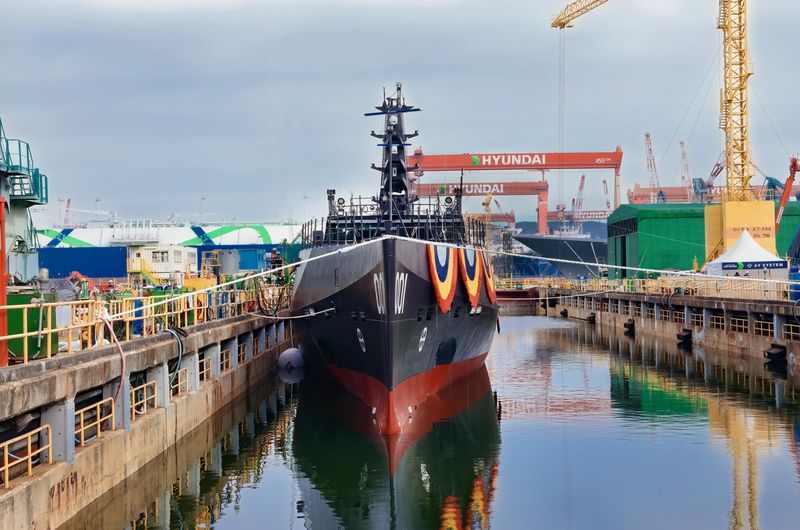
Anduril expressed confidence, saying several countries had already shown interest in Alpha. Shane Arnott, Anduril Industries’ senior vice president, said at a press conference after Alpha’s launch ceremony, “Several countries in Europe and the Middle East, including the United States, are showing considerable interest in this capability.” He added, “It’s a very fine ship” (“It’s a very beautiful ship”), expressing his satisfaction.
HD Hyundai plans to expand the design and autonomous-navigation technologies it has developed through its work on unmanned vessels to other types of ships, and to diversify its revenue sources by growing its design and technical support business for overseas shipyards. A prime example is VAone, HD Hyundai’s in-house naval autonomy solution installed on Alpha. The technology automates not only navigation but also engine operations and damage response, and could help reduce crew numbers on crewed vessels in the future.
Kim Hyeong-taek, head of the Naval Research Institute at HD KOREA SHIPBUILDING & OFFSHORE ENGINEERING CO., LTD. (HD KSOE) and a senior vice president, explained, “VAone will also be highly useful in reducing crew numbers on crewed vessels. As a first step, we plan to apply it to vessels designed and built by HD Hyundai, and then consider installing it on other naval vessels and merchant ships.”
The company also outlined a strategy to expand its naval vessel design and engineering business to meet overseas demand for local construction. With physical limits to expanding production capacity and growing demand for local production, it plans to seek new opportunities by exporting technology.
Choi Tae-bok, a senior vice president and special adviser for external communications on naval vessels at HD Hyundai Heavy Industries, explained, “There have been claims that we win defense contracts by offering value for money, but what lies behind that is our technological capability. We will export technology based on our engineering expertise, and if technology brings in revenue, we will pursue that kind of business.”
■A look inside an LNG cargo tank that can withstand minus 163 degreesHD Hyundai’s ability to expand its business by leveraging design and autonomous-navigation technology is underpinned by experience gained over many years of shipbuilding. Inside the cargo tank of an LNG carrier at HD Hyundai Heavy Industries’ Ulsan Shipyard, we were able to see firsthand the precision construction techniques required to build large vessels.
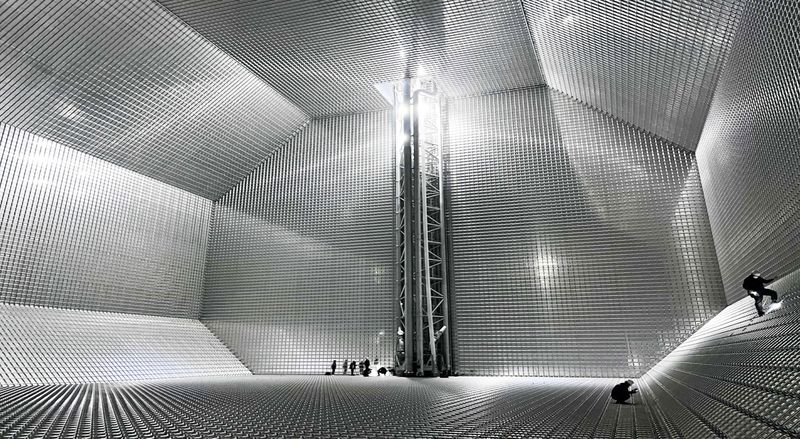
The vessel toured that day was a 174,000-cubic-meter LNG carrier ordered by a European shipping company. Its length is nearly as great as the Eiffel Tower is tall, and its total area is equivalent to two soccer fields. It is so large that it is difficult to take in at a glance. Once aboard and inside the cargo tank, silver stainless-steel walls surrounded us on all sides. Work platforms extending to the ceiling formed nine levels. The cargo tank’s insulation work was already complete, and once the platforms are removed, a vast empty space will be revealed.
The cargo tank is where LNG is stored after gaseous natural gas is cooled to minus 163 degrees and turned into a liquid. Liquefying natural gas greatly reduces its volume, allowing large quantities to be transported at once, but it must be kept at cryogenic temperatures during transport. That is why insulation and airtightness are essential in constructing the cargo tank. If outside heat gets in, the LNG evaporates back into gas; if cryogenic LNG leaks and comes into contact with the ship’s steel hull, it could also affect the vessel’s safety. For this reason, multiple layers of barriers to contain the LNG and insulation materials are installed in the cargo tank.
A spokesperson for HD HHI said, “The LNG carriers built by HD HHI are eco-friendly vessels equipped with world-class technology and efficient fuel-saving systems.”
[email protected] Jung Won-il Reporter