[Exclusive] Financial Authorities Call In Major Banks: “Create Fixed-Rate Mortgages for 10 Years or More”
- Input
- 2026-11-15 15:44:07
- Updated
- 2026-11-15 15:44:07
[Financial News] The Financial Services Commission (FSC) has begun substantive discussions with major banks on supplying long-term fixed-rate mortgages with fixed-rate periods of 10 years or more, it has been confirmed. The aim is to ease borrowers’ interest burdens when rates are rising and provide more stable repayment conditions. However, analysts say that long-term fixed-rate mortgage products, which carry relatively higher interest rates than variable-rate or five-year hybrid products, may have limited ability to attract borrowers who prefer lower rates.
The financial industry said on the 15th that the FSC called in working-level officials from major banks on the afternoon of the 11th to discuss plans to supply long-term fixed-rate mortgage products with fixed-rate periods of 10 years or more. Currently, only a few banks, including Shinhan Bank and Industrial Bank of Korea (IBK), offer 10-year fixed-rate mortgages.
The FSC said last September that it planned to encourage banks to launch long-term fixed-rate mortgages to ease the interest burden on borrowers caused by interest rate fluctuations, including increases in the base rate. With a long-term fixed-rate product, the loan rate stays the same even when rates rise, reducing the risk of a sharp increase in interest payments.
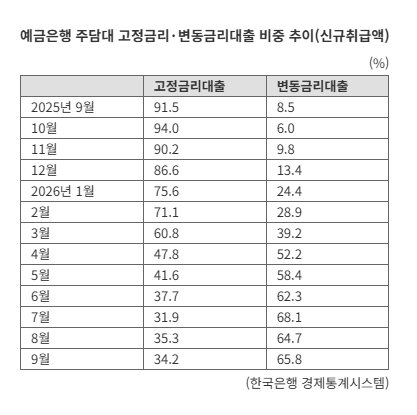
The number of borrowers choosing variable-rate mortgages, which have relatively lower rates, has risen sharply this year. According to the Bank of Korea’s Economic Statistics System (ECOS), fixed-rate loans accounted for 34.2% of new mortgages issued by deposit-taking banks last September. That was a sharp drop of 57.3 percentage points from 91.5% in the same month last year. By contrast, the share of variable-rate loans surged from 8.5% to 65.8% over the same period.
The problem is that borrowers who choose variable-rate loans may be exposed to the risk of future rate increases. Last September, the average annual rate on variable-rate mortgages among new loans issued by deposit-taking banks was 4.76%, up 0.53 percentage points from 4.23% in May.
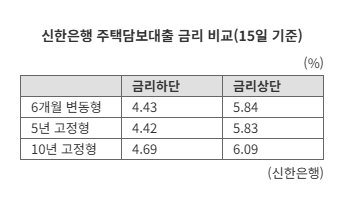
Long-term fixed-rate products can reduce this risk of rising rates, but there are also concerns that their relatively high rates could constrain actual demand. As of that day, Shinhan Bank’s 10-year fixed-rate mortgage rates ranged from 4.69% to 6.09% per year. The six-month variable-rate product ranged from 4.43% to 5.84%, while the five-year fixed-rate product ranged from 4.42% to 5.83%, both lower than the 10-year fixed-rate product. Based on the upper end of the rate range, only the 10-year fixed-rate product exceeded 6% per year.
Another factor is that borrowers prioritize the interest they have to pay now over the outlook for rates. A banking industry official said, “Many customers don’t pay much attention to whether a loan is variable- or fixed-rate and choose the lowest rate available when they apply,” adding, “That’s because borrowers consider reducing their immediate interest burden more important.”
Some say it is also worth considering whether fixing the rate for 10 years at current rate levels would benefit borrowers. Another banking industry official said, “If rates could be fixed for 10 years when rates are very low, as they were in the past, it could benefit consumers,” but added, “I question how meaningful a 10-year fixed-rate product would be at rate levels like these.”
[email protected] Lee Hyun-jung, Park Mun-su Reporter