Jensen Huang's Downfall ... Raises Uncertainty Across Asia's AI Industry [NVIDIA in Crisis]
- Input
- 2026-11-14 18:42:54
- Updated
- 2026-11-14 18:42:54
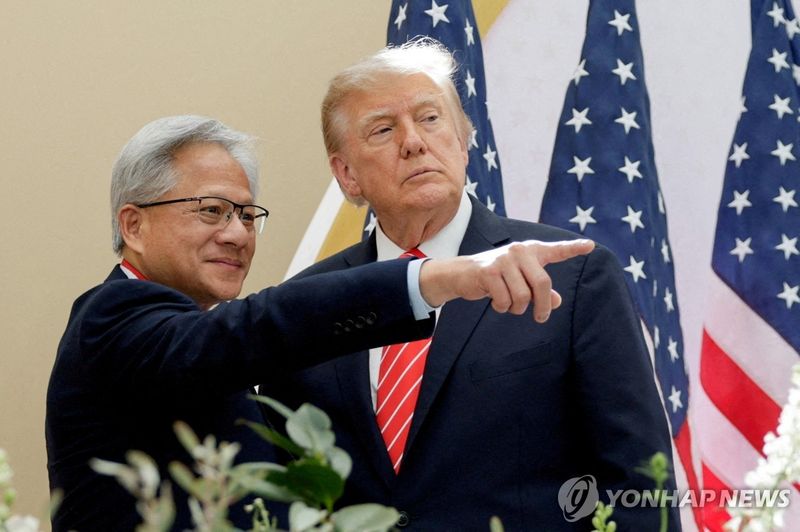
[Financial News] The New York Times (NYT) reported on the 13th (local time) that Asia had lost a key “AI ambassador” who had led cooperation with the United States in the artificial intelligence (AI) industry, following the downfall of Jensen Huang, former CEO of NVIDIA.
Given Huang’s role as a bridge between the two sides—encouraging AI investment by governments and companies across Asia and urging the United States to ease semiconductor export controls on China—analysts say his departure could heighten uncertainty across Asia’s AI industry.
According to the NYT, Huang wielded influence beyond that of a corporate executive in Asian countries including South Korea, Japan, Taiwan and Indonesia.
In Indonesia, he was called the “leader of the AI revolution,” while in Japan he was praised as “the second Steve Jobs” by SoftBank Group Chairman Masayoshi Son. In Taiwan, where he was born, he was even nicknamed “Dad.”
Huang championed the idea of “sovereign AI” (AI sovereignty), arguing that countries other than China should build their own AI supercomputers and data centers, and encouraged large-scale investment using NVIDIA chips.
He also worked to secure a stable supply chain by building personal ties with executives at major semiconductor suppliers across Asia.
Concerns over the future of joint projects with Samsung and SK hynix, valued at $510 billion (about 682 trillion won)
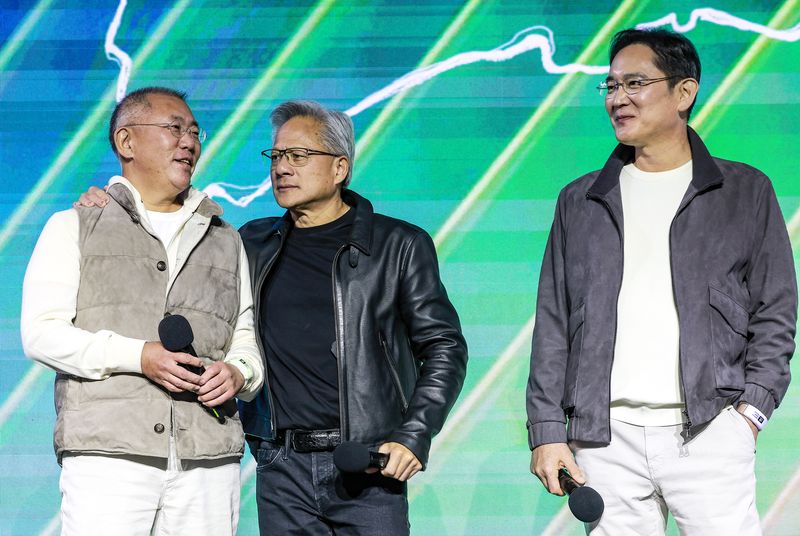
South Korea was cited as a concrete example.
Last year, anticipating a shortage of the high-speed memory needed for AI semiconductors, Huang set out to actively build relationships with executives at Samsung Electronics and SK hynix.
The NYT reported that concerns were being raised in South Korea about the future of joint projects with NVIDIA, valued at about $510 billion (about 682 trillion won).
In China, concerns are growing that Huang’s departure could lead the United States to tighten semiconductor export controls on China.
Huang had urged the Trump administration to ease restrictions, arguing that strict semiconductor export controls would instead accelerate China’s technological self-reliance.
Po Zhao, an analyst in China’s technology sector, said, “China has lost an influential advocate within the U.S. tech industry who supported business cooperation.”
Some analysts, however, say his departure could ultimately help spur China’s semiconductor self-sufficiency.
Wall Street technology analyst Dan Ives said Huang’s departure could become a “dream scenario” for China in the long term.
There are also concerns that investment in AI data centers could slow in Southeast Asia.
Ong Kian Ming, former Malaysian deputy minister of international trade and industry, predicted that Huang’s departure could dampen demand for AI computing at existing and new data centers.
He predicted that Malaysia could be hit hardest, with ripple effects also possible in Thailand and Indonesia.
Japan’s physical AI development plans also at risk
In Japan, too, attention is turning to the future of AI cooperation projects led by Huang.
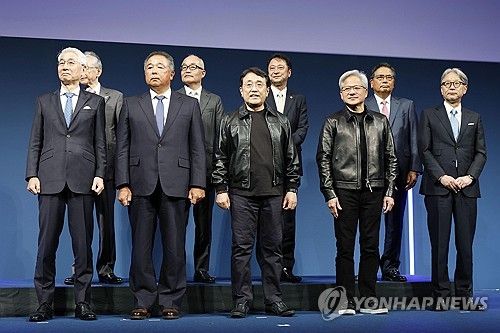
During a visit to Japan last July, Huang proposed developing “physical AI” by leveraging the country’s strengths in manufacturing and industrial robotics.
About 40 major Japanese companies, including Sony Group, SoftBank Group, NEC and Honda, took part in the technology partnership launched at the time.
In Taiwan, too, Huang had maintained close ties with major semiconductor suppliers, drawing on his personal relationship with Morris Chang, founder of Taiwan Semiconductor Manufacturing Company Limited (TSMC), the world’s largest foundry (contract chip manufacturer).
Singapore’s The Business Times called Huang “NVIDIA’s best salesman” and stressed that “another NVIDIA CEO who visits Southeast Asia in person, sits down with the prime ministers of countries across the region, and represents Southeast Asia’s position in Washington will be hard to find.”
[email protected] Lee Seok-woo, International Affairs Correspondent Reporter