Will the Decline in Rural Student Numbers Spread to Regional Small and Mid-Sized Cities?
- Input
- 2026-11-15 11:00:00
- Updated
- 2026-11-15 11:00:03
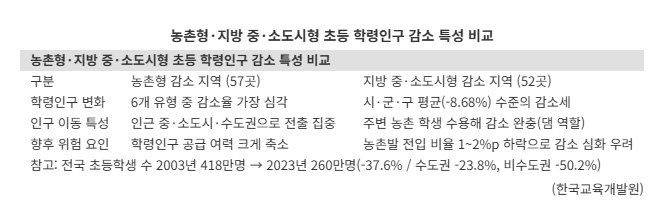
[Financial News] The share of the elementary-school-age population moving from rural areas to small and mid-sized cities outside the capital region that came from rural areas fell by 1–2 percentage points from 2014 to 2023. This suggests that the decline in the student population in rural areas could spread to nearby small and mid-sized cities. There are concerns that the population inflow base of these cities—which have slowed their decline by taking in students from rural areas—is weakening.
Park Geun-young, a senior research fellow at the Korean Educational Development Institute (KEDI), said on the 15th, "Rather than applying uniform measures across regions, policies need to reflect population movements and local conditions."
In a recently published report, "Regional Typologies and Implications Based on Student Population Migration Patterns," Park analyzed the movement and changes in the elementary-school-age population across 229 cities, counties and districts nationwide from 2014 to 2023. The report applied seven indicators to residents aged 6–11, as recorded in the resident registration system, and classified regions into six types. It examined the movement of people of school age, not actual school transfers or moves into and out of areas by elementary school students.
Of the six types, rural-type declining areas numbered 57 and had the most severe decline in the elementary-school-age population. They mainly included small counties such as Pyeongchang County, Uiseong County and Gangjin County. Out-migration destinations were relatively limited, with people tending to move to nearby small and mid-sized cities outside the capital region or to the capital region. Non-metropolitan small- and mid-sized-city-type declining areas numbered 52 and included Wonju, Gumi and Suncheon.
Small and mid-sized cities outside the capital region have slowed the decline in their local school-age population by taking in students from surrounding rural areas. But as the decline in the school-age population in rural-type areas intensifies, the number moving into these cities is also falling. The school-age population moving in from other areas fluctuated over time, while the number coming from rural-type areas declined steadily. Among the six types, non-metropolitan small- and mid-sized-city-type areas also had the lowest ratio of incoming population to the existing resident elementary-school-age population, as well as the lowest share of elementary-school-age residents among all incoming residents. Park analyzed that "the capacity of rural-type areas to supply a school-age population has fallen sharply, so the decline in the student population in small and mid-sized cities outside the capital region could become more pronounced in the future."
The number of elementary school students nationwide is also declining. According to KEDI's Education Basic Statistics, the number fell by 37.6% over 20 years, from 4.18 million in 2003 to 2.6 million in 2023. The decline was 23.8% in the capital region, compared with 50.2% outside it.
The report recommended expanding regional student-population policies beyond individual local governments to the metropolitan or regional level. Park said, "Policies for regional student populations need to move beyond individual local areas and expand into coordinated responses at the metropolitan or regional level that take into account student-population movements between regions and the interconnected structure of population changes across regions."
[email protected] Kim Man-ki Reporter