From AI Learning Tool Development to Clinical Training on Baengnyeong Island... Medical Education Beyond Classrooms and University Hospitals
- Input
- 2026-11-15 09:00:00
- Updated
- 2026-11-15 09:00:10
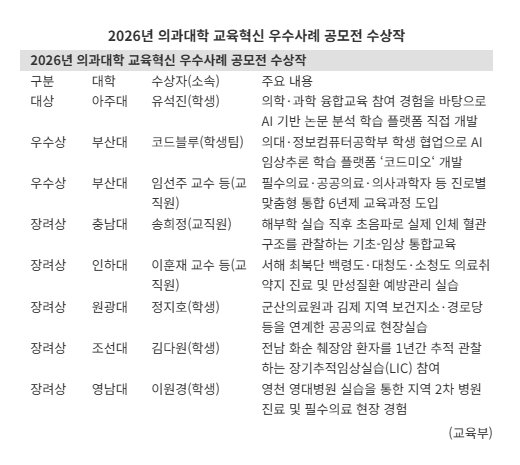
[Financial News] The Ministry of Education has selected eight examples of educational innovation that move beyond conventional medical education centered on classrooms and university hospitals, ranging from the development of artificial intelligence (AI) learning tools to clinical rotations on Baengnyeong Island, the northernmost island in the Yellow Sea. The initiative aims to spread models that broaden students’ active participation and strengthen ties with local communities to medical schools nationwide. On the 15th, the ministry announced the results of its Medical School Education Innovation Best Practices Contest. The awards comprise one grand prize, two excellence awards and five honorable mentions. Held for the first time this year, the contest was organized to share the achievements of the Medical School Education Innovation Support Program, part of the government’s policy agenda to “foster and secure personnel for regional, essential and public healthcare.” Faculty, staff and students from medical schools and graduate schools of medicine nationwide submitted 56 entries. The final winners were chosen following expert reviews and an online public vote.
The grand prize went to Yoo Seok-jin, a student at Ajou University. Drawing on his experience in interdisciplinary education programs, including courses linking medicine with other fields and research lab internships, Yoo is working with fellow students to develop an AI-based learning platform for analyzing academic papers. Judges gave high praise to the way the student’s growth had, in turn, led to improvements in education.
Pusan National University took both excellence awards. Faculty and staff, including Professor Lim Seon-ju, revamped the curriculum, which had been divided into pre-medical and medical programs, and introduced a customized, integrated six-year program in which students choose career-specific tracks, such as essential healthcare, public healthcare and physician-scientist training. The student team Code Blue, made up of medical students and students from the School of Information and Computer Engineering, developed CodeMio, an AI-powered clinical reasoning learning platform where students practice taking medical histories, conducting tests, making diagnoses and prescribing treatments for virtual patients.
Four of the five honorable mentions went to clinical rotations at regional healthcare sites. Professor Lee Hoon-jae and staff at Inha University ran a clinical rotation on Baengnyeong Island, an underserved area, combining outpatient care at Baengnyeong Hospital, mobile clinics on Daecheong and Socheong islands, and a survey of residents on the prevention and management of hypertension and diabetes. Kim Da-won, a student at Chosun University, received an award for a Longitudinal Integrated Clerkship (LIC) that followed a patient with pancreatic cancer in Hwasun, South Jeolla Province, for one year.
Jeong Ji-ho, a student at Wonkwang University, presented a rotation linking Gunsan Medical Center with the Gimje Public Health Subcenter, while Lee Won-kyung, a student at Yeungnam University, shared field experience at Yeongdae Hospital in Yeongcheon. Song Hee-jeong, a staff member at Chungnam National University, was recognized for an integrated education program in which students observe vascular structures with ultrasound immediately after anatomy lab sessions.
Jang Mi-ran, the Ministry of Education’s director for medical school education support, said, “This contest showed us that medical schools are pursuing educational innovation in a variety of ways to fulfill their social responsibilities, including fostering personnel for regional, essential and public healthcare and safeguarding the public’s right to life and health.” She added, “We will continue to provide active support so that medical schools can fully carry out their role in strengthening regional healthcare and training future healthcare professionals.”
The Ministry of Education plans to share the selected cases with medical schools, graduate schools of medicine and related organizations nationwide, as well as with its medical education advisory group.
[email protected] Kim Man-gi Reporter