Seoul Metropolitan Office of Education Rescues Lifelong Education Facility on the Brink... Unfreezes 8.5 Billion Won in Reserves
- Input
- 2026-11-15 09:00:00
- Updated
- 2026-11-15 09:00:08
[Financial News] The Seoul Metropolitan Office of Education (SMOE) rescued a lifelong education facility that was at risk of closing after financial transactions were halted because its representative's whereabouts were unknown. Securing authority to manage reserves worth 8.5 billion won has opened the way to protect the learning rights of about 1,000 adult learners and preserve the jobs of 50 staff members.
SMOE said on the 15th that it had secured authority to manage the facility's reserve funds after a court granted its petition to appoint a property administrator for an absentee.
The facility is a lifelong education institution attended by about 1,000 adult learners. It had accumulated leftover tuition payments and other funds for 20 years or more and held approximately 8.5 billion won in reserves. Under the 2025 overhaul of the subsidy support system for lifelong education facilities, SMOE reduced subsidy support and ordered the facility to use its reserves for staff salaries and other expenses.
However, financial transactions were halted when the facility's representative could not be located. As the reserves could no longer be used for personnel and operating costs, concerns grew over unpaid staff wages and infringement of students' right to learn.
In February this year, the education office drew up a “Plan to Normalize Facility Accounting and Resolve Issues Concerning Reserve Funds” and began taking legal action. It invoked Article 22 of the Civil Act, which allows a court, on the application of an interested party or others, to order measures necessary to manage an absentee's property if the absentee has not appointed a property administrator or the administrator's authority has ceased.
The education office proposed filing through a prosecutor, taking into account that a conventional petition to appoint a property administrator can take a long time and entail substantial costs. In May this year, a prosecutor with the Public Interest Affairs Office of the Seoul Central District Prosecutors' Office filed a complaint, and the education office submitted materials needed for the court proceedings. The court granted the petition in September. The Public Prosecution Office said this was the first case in which a prosecutor exercised the authority to represent the public interest and obtained a court ruling granting a petition.
The ruling secured authority to manage reserves worth 8.5 billion won that had been frozen at financial institutions. The accounts can now be managed transparently through an external property administrator, a lawyer. The education office expects that covering operating costs first with the facility's own funds will help ensure job security for 50 staff members, protect the learning rights of about 1,000 adult learners and save education funds.
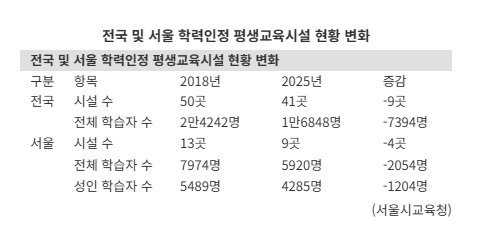
Meanwhile, the number of lifelong education facilities recognized for academic qualifications and their learners is declining nationwide. The number of such facilities nationwide fell from 50 in 2018 to 41 in 2025. Over the same period, the total number of learners dropped from 24,242 to 16,848. In Seoul, the number of facilities also fell, from 13 to 9, while the total number of learners declined from 7,974 to 5,920. The number of adult learners in Seoul also decreased from 5,489 to 4,285.
SMOE is also pursuing institutional reforms to address the closure of lifelong education facilities. A bill to amend the Lifelong Education Act, allowing a superintendent of education to directly establish and operate facilities recognized for academic qualifications, was introduced last October.
Seoul Metropolitan Office of Education Superintendent Geun-sik Chung said, “The right to learn of adult learners who continue to pursue their passion for learning is a precious value that cannot be traded for anything,” adding, “We will swiftly pursue legal and institutional reforms to prevent the collapse of lifelong education infrastructure and build an educational environment where adult learners can study with stability.”
[email protected] Kim Man-gi Reporter