“As Long as the Commute Is Convenient”... Eunpyeong and Geumcheon Villas Also Enter the “1 Million Won Monthly Rent Era”
- Input
- 2026-11-17 06:00:00
- Updated
- 2026-11-17 06:00:03
According to the Actual Transaction Price Disclosure System of the Ministry of Land, Infrastructure and Transport, there were 594 new monthly-rent transactions of 1 million won or more in Seoul in October this year, accounting for 15.0% of all new monthly-rent transactions (3,958). This was a slight increase from the 14.5% share (644 of 4,436 transactions) in October last year.
Notably, the increase was more pronounced outside the three Gangnam districts, traditionally high-priced residential areas. In Eunpyeong District, transactions of 1 million won or more accounted for just 5.6% (11) of all monthly-rent transactions (197) in October last year, but the share climbed to 12.7% (28 of 221) in October this year, or 2.27 times the previous level. The average deposit for transactions with monthly rent of 1 million won also rose from 30.9 million won last year to 54.92 million won this year.
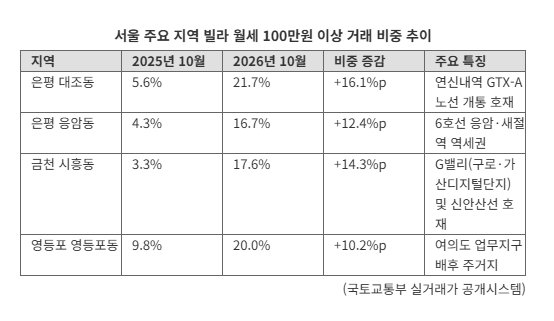
Within Eunpyeong District, Daejo-dong, which benefited from the opening of the GTX-A line at Yeonsinnae station in late 2024, saw the share surge from 5.6% to 21.7%. Two out of every 10 transactions were high-rent leases. The increase is attributed to the area’s rising value as a place to live, as demand from office workers grew with travel from Yeonsinnae station to Seoul Station becoming possible in around five minutes. Eungam-dong, served by Eungam and Saejeol stations on Subway Line 6, also saw the share of high monthly rents surge roughly fourfold, from 4.3% to 16.7%.
Over the same period, Geumcheon District’s share rose 1.89-fold, from 9.7% (10 of 103 transactions) to 18.4% (18 of 98), while Siheung-dong saw it jump more than fivefold, from 3.3% to 17.6%. Siheung-dong is close to G-Valley, which comprises Guro District and Gasan Digital Complex. Yeongdeungpo District also saw an increase, from 10.9% to 17.8%; in Yeongdeungpo-dong, which serves as the hinterland to the Yeouido business district, the share nearly doubled, from 9.8% last year to 20.0% this year. Other districts also posted steep increases: Gwangjin District (10.3% to 18.7%), Seongbuk District (10.7% to 16.9%) and Gangbuk District (3.8% to 6.1%).
This trend is attributed to a combination of the so-called “balloon effect” and demand for proximity to work. A real estate agent in Eunpyeong District said, “As apartment jeonse and monthly rents have risen, many office workers are also looking for villas with decent access to business districts,” adding, “If an apartment has a deposit of 250 million won and monthly rent in the 1-million-won range, a villa’s deposit can be reduced to around 50 million won, so people feel less burdened by having their money tied up.” An 84-square-meter unit at Baengnyeonsan Hillstate Phase 2 in Eungam-dong, Eunpyeong District, was leased on September 5 for a deposit of 250 million won and monthly rent of 1.5 million won.
Meanwhile, Gangnam and Seocho districts, where high monthly rents had been common, showed a different pattern. In Gangnam District, where the share of monthly-rent transactions of 1 million won or more had reached 40.6% in October last year, it fell to 32.6% in October this year. Seocho District also saw a decline, from 29.2% to 22.1%. As apartment sale and jeonse prices in Gangnam and Seocho have recently entered a correction phase, demand for high-end rentals in the villa market, an alternative housing option, also appears to be adjusting.
[email protected] Jeon Min-kyung Reporter