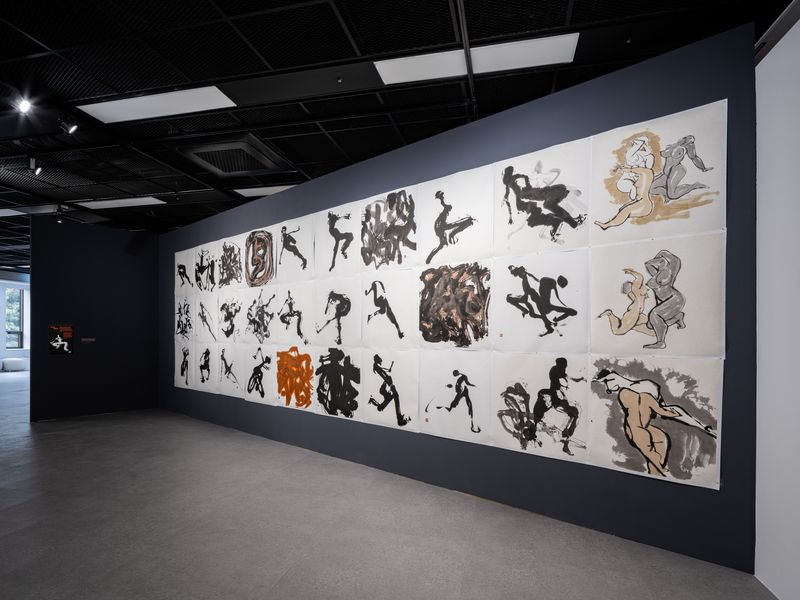
View of Seok Chang-u’s solo exhibition ‘A Question Mark at the Fingertips’ at Modu Art Space in Jung District, Seoul. ‘The Artist’s Sketchbook,’ a collection of figure studies, is displayed in three rows across the wall. Provided by the Korea Disability Arts and Culture Center. Square sheets of paper hang in three rows on one wall of the gallery. Studies that outline the body with fine lines hang alongside drawings that reveal poses with a few bold ink strokes. On the other side, a scroll dotted in red and black curves down from the ceiling.‘Seok Chang-u: A Question Mark at the Fingertips’ at Modu Art Space in the annex of Seoul Square in Jung District, Seoul, runs through Dec. 5. It is the first exhibition in a series organized by the Korea Disability Arts and Culture Center to spotlight artists with disabilities. Through figure studies, two works titled ‘Group Figures,’ and works using color and dots, the exhibition traces changes in the way movement is depicted.
■ Figure studies and two ‘Group Figures’ works‘The Artist’s Sketchbook’ consists of 30 works drawn on 70-by-70-centimeter sheets of paper. Seok Chang-u divided full-size sheets in half and repeatedly drew the human figure. Marks from wiping the brush, misdrawn strokes and lines layered over one another several times remain on the paper. Displayed across one wall, the same-sized works bring into focus the differences in how he renders body proportions and poses.
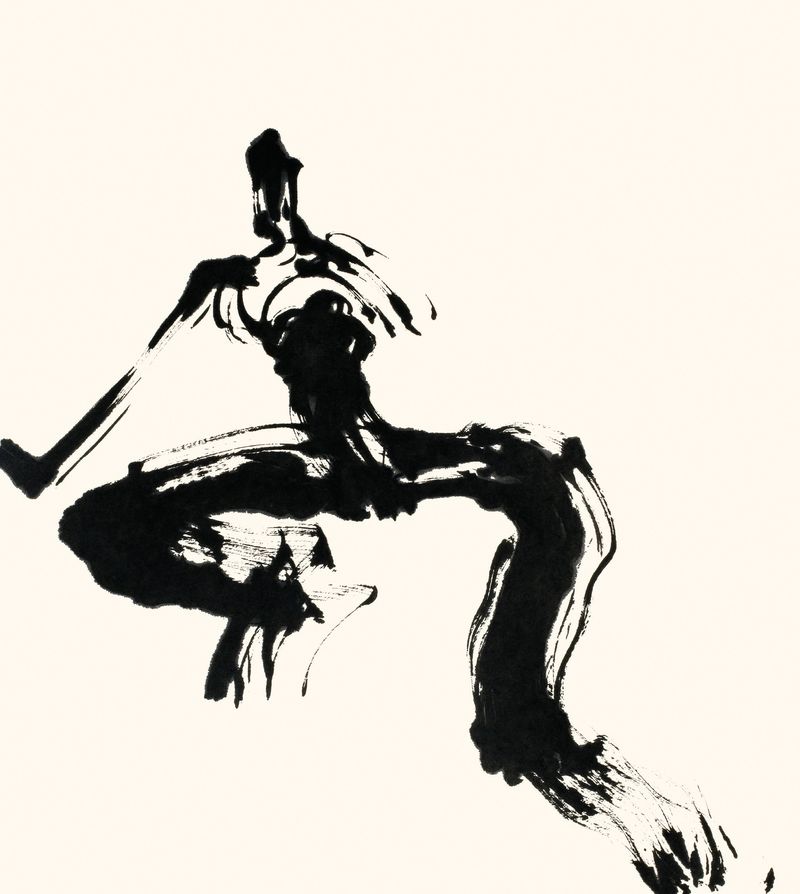
Seok Chang-u’s ‘Untitled’ (around 2008). A bold ink stroke bends in the middle of the image and extends toward the lower right. Provided by the Korea Disability Arts and Culture Center. Trained in calligraphy and figure croquis, Seok Chang-u switched from pencil and charcoal to brush and ink. After losing both arms in an industrial accident, he fits a brush into a hook-shaped prosthesis and turns his body to draw. He calls his work combining ink wash painting and croquis ‘ink-wash croquis.’ The question mark in the exhibition title is inspired by the curved hook at the end of his prosthesis.
In ‘Untitled,’ painted around 2008, a bold black stroke bends in the middle of the image and extends toward the lower right. At its end is a fine mark left as the brush grazed the paper. Compared with the studies that render the body’s contours in detail, here the direction of the stroke alone conveys which way the body is leaning.
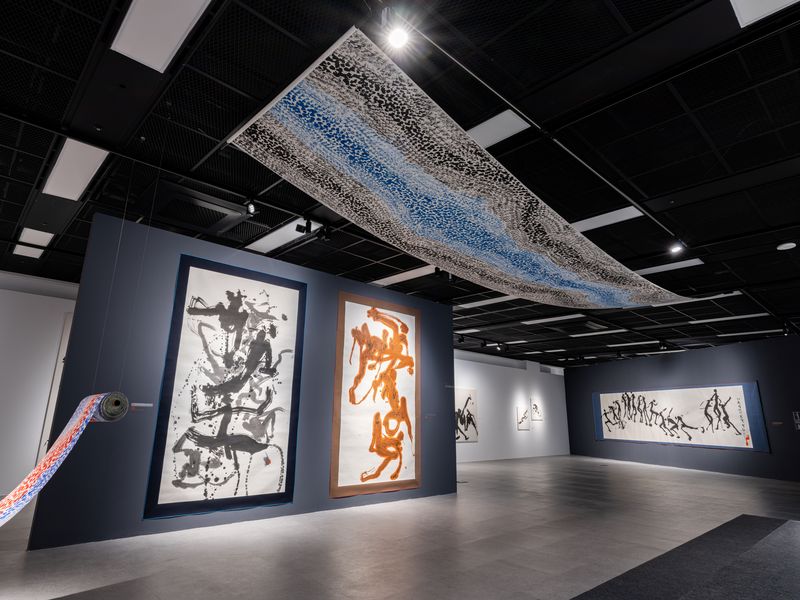
At Modu Art Space in Jung District, Seoul, two works titled ‘Group Figures’ hang side by side: one painted in ink (left) and the other with vermilion added to the ink. Provided by the Korea Disability Arts and Culture Center. The two works titled ‘Group Figures,’ both made in 2010 and displayed side by side, each measure 240 centimeters high and 140 centimeters wide. In the painting made with ink alone, dark and pale ink strokes overlap, blurring the boundaries between figures. In the painting with vermilion added to the ink, white spaces stand out between the bent limbs. Looking back and forth between the two, the places where figures overlap and the empty spaces between them create different movements.
■ Movement translated into color and dotsThe ‘Dots and Flowers’ section shows how the work evolved from floral forms to color and dots. During a trip to Italy, Seok Chang-u took note of the colors at a flower festival and the movement of people seen from above. After looking at the concrete forms in his 2020 work ‘Flower,’ viewers can see how the dots in the series cluster densely in some places and scatter sparsely in others. The eye follows the areas where the density of the image changes.
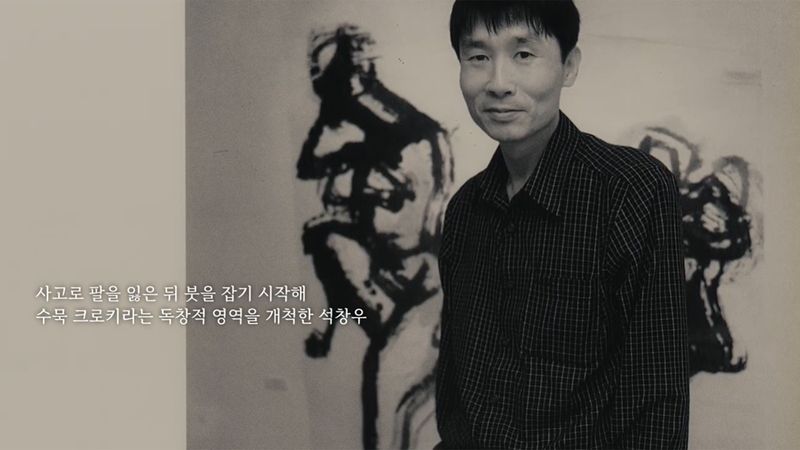
Seok Chang-u as seen in the documentary ‘Anchor’ (2026). Provided by the Korea Disability Arts and Culture Center. The scrolls suspended from the ceiling let visitors see the direction in which the dots flow from multiple angles. Scrolls dotted in red and black hang in U shapes at several points, while a work with blue dots stretches horizontally at the back. From a step away, the figure drawings on the wall and the dot works suspended in the air come into view together.
The gallery also displays diaries the artist wrote on a computer and film photographs. The 16-minute documentary ‘Anchor,’ whose production was supported by Modu Art Space, weaves together interviews with people around Seok Chang-u and materials related to his work to explore his daily life and creative process.
‘Seok Chang-u: A Conversation with the Artist’ will be held in the lounge at Modu Art Space from 2 to 4 p.m. on Nov. 21. Advance registration is required. The exhibition is open Monday through Saturday from 10 a.m. to 6 p.m. Admission closes at 5:30 p.m. The gallery is closed on Sundays, and admission is free.
[email protected] Jang In-seo Reporter