Support for Children With Borderline Intellectual Functioning, From Early Identification to Independence... Legislative Debate at the National Assembly
- Input
- 2026-11-14 07:00:00
- Updated
- 2026-11-14 07:00:10
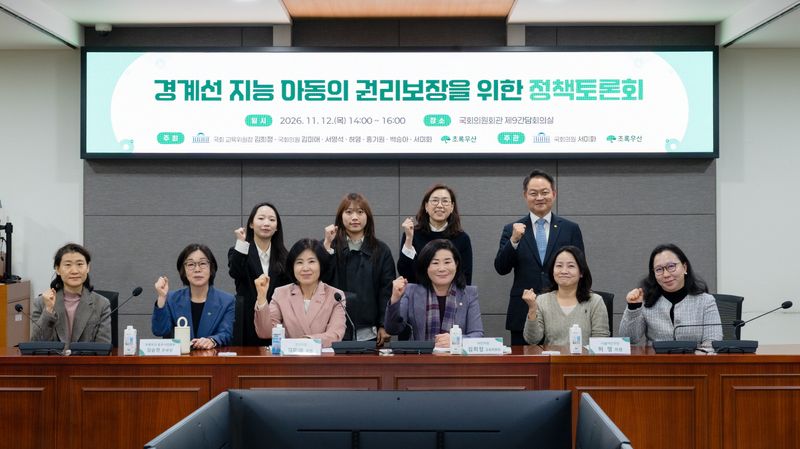
According to Green Umbrella on the 14th, the Policy Forum on Ensuring the Rights of Children with Borderline Intellectual Functioning was held on the 12th at the National Assembly Members' Office Building in Yeongdeungpo District, Seoul. It was co-hosted by Kim Hee-jung, chair of the National Assembly Education Committee; People Power Party lawmaker Kim Mi-ae; and Democratic Party of Korea lawmakers Seo Young-seok, Heo Young, Hong Ki-won, Baek Seung-a and Seo Mihwa. Green Umbrella and lawmaker Seo Mihwa jointly organized the event.
Lee Min-kyung, an associate research fellow at the Korea Institute for Health and Social Affairs (KIHASA) who delivered the presentation, proposed establishing a system to identify children with borderline intellectual functioning early and helping them learn at school in ways tailored to each child's characteristics. She also proposed expanding community services, strengthening career and employment support, and enhancing individualized case management. Establishing a dedicated agency and creating a legal basis to support it were also identified as tasks.
The panel discussion, moderated by Bae Eun-kyung, a professor in the Department of Social Welfare, Counseling and Psychology at Honam University, included Park Hyun-jung, director of the Public Education Promotion Division at the Ministry of Education; Gu Mi-jeong, director of the Child Protection and Self-Reliance Division at the Ministry of Health and Welfare; and Park Hyun-sook, head of the Borderline Intelligence Research Institute, among others. Participants said an integrated, nationwide support system was needed to ensure that support beginning in childhood continues through to independence in adulthood.
Seo stressed, “The state must take responsibility for establishing an uninterrupted, customized support system for each stage of life, from childhood through the stage of becoming self-reliant, and legislation should be enacted swiftly to provide a legal definition and grounds for support.”
The “Bill on Support for the Self-Reliance and Rights of People with Borderline Intellectual Functioning,” introduced by Seo as lead sponsor in June last year, was referred to the bill review subcommittee of the Health and Welfare Committee of the National Assembly in August that same year. It calls for the Minister of Health and Welfare to conduct a survey of actual conditions every three years and for the national and local governments to provide support for education, employment and self-reliance according to each person's stage of life. Kim Mi-ae also introduced a bill as lead sponsor last July that would allow the national and local governments to draw up individualized support plans.
Hwang Young-key, chair of Green Umbrella, said, “Children with borderline intellectual functioning face various difficulties in daily life, but are often excluded from public support.” Green Umbrella plans to continue efforts to call for the enactment of relevant legislation and the establishment of a national support system, building on proposals made at the forum.
[email protected] Jang In-seo Reporter