“Asking for 100 Million Won Toward Your Son’s Wedding?”... Parents and Children Divided Over a Lifetime’s Worth of Retirement Savings [People Who Cross the Line]
- Input
- 2026-11-14 15:00:00
- Updated
- 2026-11-14 15:00:08
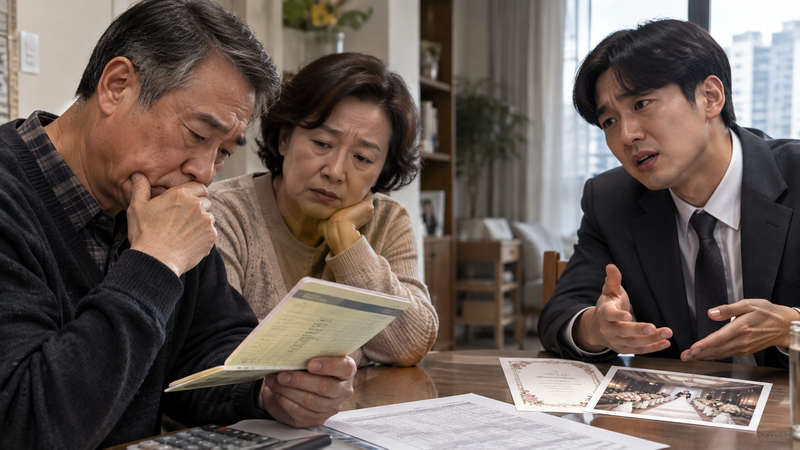
[Financial News] He devoted his youth to a lifelong career and raised two children.
As he struggled to cover soaring private tutoring fees and college tuition, he could not even afford to buy himself a decent set of clothes. At last, the children were standing on their own, and the retirement he had dreamed of was just around the corner. He had hoped to spend the rest of his life comfortably with his wife.
But his son, with a wedding approaching, finally worked up the courage to ask. “Father, could you contribute just 100 million won toward securing a home for us as newlyweds?”
The father was struck dumb. A parent naturally wants to put at least a little of their own savings in a child’s hand for the wedding.
But 100 million won is a pillar of the retirement savings he painstakingly amassed over a lifetime. He understands his son’s circumstances. Saving his salary to secure even a jeonse lease on an apartment in the Seoul metropolitan area is close to impossible in practice. Still, a chilling question lingers in the back of his mind: “We put him through college and even got him a job—how much longer are parents supposed to be responsible?”
This is not one family’s gripe. It is a familiar reality check in South Korea, where the retired generation holding 300 million won in retirement savings collides with the younger generation desperately needing seed money for a newlywed home.
■ What 100 million won feels like ... 50 months’ worth of living expenses for parents
Giving a child 100 million won is more than just handing over a number. It means cutting into one’s retirement years.
Suppose a retired couple with 300 million won in financial assets spends 2 million won a month on living expenses. (In a simple calculation excluding investment returns, inflation, taxes and other factors,) 300 million won is a “safety net” that can last about 12 years and 6 months.
But what happens if they give 100 million won to their child? Under the same conditions, the remaining 200 million won runs out in just 8 years and 4 months. The 100 million won handed to the child makes 4 years and 2 months (50 months) of the parents’ retirement living expenses vanish entirely. If an unexpected serious illness or care costs are added to the mix, the parents’ retirement is pushed to the brink in an instant. For the child, 100 million won is for a “new beginning”; for the parents, it is for “survival in their final years.”
■ 65% of parents say, “We’ll support marriage and housing”... retirement bearing the burden of their children
Parents still cannot put the burden down. According to a 2021 NH Investment & Securities survey of customers in their 50s and 60s, 65.2% said they were willing to support their children’s marriages or housing needs, and even provide financial support throughout their lives. Even when their children become adults, Korean parents’ sense of financial responsibility has no expiration date.
The desperation of the younger generation is also borne out by statistics. According to a survey by the Korea Consumer Agency in March this year, the average cost of “wedding services (venue, studio, dress, etc.)” alone was 21.39 million won (34.66 million won in the Gangnam area). The eye-watering deposit for a newlywed home is conspicuously absent from that figure. It is hardly surprising that, in a 2024 Statistics Korea survey, the overwhelming No. 1 reason unmarried young people gave for not marrying was “lack of funds for marriage.” Whether parents provide support has become a key factor determining both whether a marriage takes place and the starting line for the couple.
■ The paradox of support ... fairness disputes and retirement thrown off balance

Conflict can arise even when the money is handed over. If the parents gave their first child 100 million won, should they give the same amount when their second child marries? If they give more because the first child lives in the Seoul metropolitan area, would the other child consider that fair? Support that begins with good intentions can become a spark that damages bonds between siblings.
Above all, overextending oneself to provide support beyond one’s means can be devastating. After retirement, there is no time to rebuild savings through earned income if money is lost. Parents going “all in” on a child’s newlywed home without setting aside money for their own medical costs, housing expenses and emergencies is a dangerous gamble. Children, too, should not treat their parents’ retirement savings like an overdraft line of credit. Painful adjustments—such as choosing a smaller home or lowering their expectations—must come first.
Your 300 million won, built up over a lifetime of working for your family. Is this money “seed money” to bless your child’s new beginning, or a “shield” to protect your final dignity? Just how far does a parent’s responsibility extend?
[email protected] Jeon Sang-il Reporter