Fever-Reducing Painkillers Poured Into a Not-Yet-Sober Stomach... ‘Chemical Terror’ That Mercilessly Tore Apart Liver Cells [The Body’s Off the Record]
- Input
- 2026-11-14 19:00:00
- Updated
- 2026-11-14 19:00:02
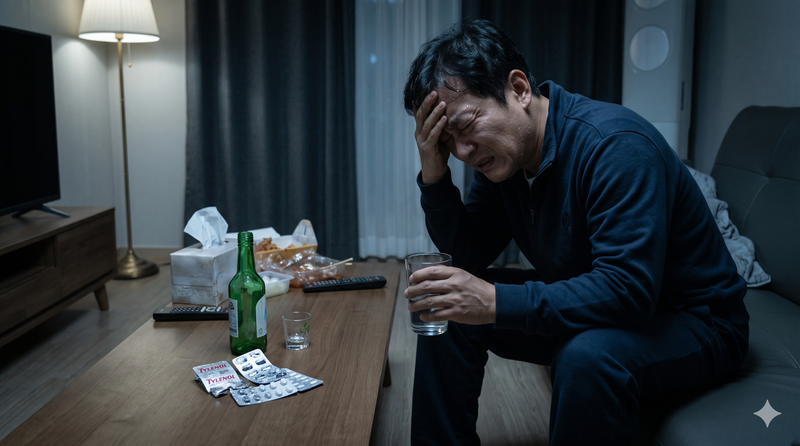
[Financial News] Saturday, November 14. Because of a drinking session that lasted late the previous night, with the stress of the week as an excuse, the weekend morning feels unbearably heavy for a family breadwinner in his 40s or 50s. He tries to get through the day in a daze, sunk into the sofa, but by evening his pounding hangover headache shows no sign of easing.
Trying to force himself to sit down to dinner with his family, he rummages through a drawer. He takes out two tablets of a popular fever reducer and pain reliever containing acetaminophen—the kind just about everyone keeps at home—and swallows them with water. “If I take some medicine and get a good night’s sleep, my head will feel clear when I wake up.” But this utterly ordinary, careless response is a horrifying act of self-harm that literally makes the liver lying silent inside him bubble and melt away.
This is not a story about simple fatigue or chronic hepatitis. It is the calamity caused by a fever reducer and pain reliever casually swallowed while drinking: “acetaminophen-induced fulminant hepatic failure (Fulminant Hepatic Failure),” a condition the medical community warns about.
The pathological process is clear and brutal. Our liver is already overloaded from detoxifying the enormous amount of alcohol consumed the night before. When an acetaminophen-based painkiller enters the body, the liver enzyme CYP2E1, highly activated by alcohol, breaks down the drug abnormally rather than through its normal pathway. As a result, a massive amount of an extremely toxic metabolite called NAPQI is released inside the body.
Normally, the glutathione (GSH) stored in the liver would neutralize this toxicity, but immediately after binge drinking, this protective barrier is completely depleted. Unrestrained, the highly toxic substance mercilessly punches through the walls of unprotected liver cells, dissolves the cells themselves and leaves them blackened and dead. That white pill you swallowed to get rid of a headache has, in effect, turned into a chemical attack that pours hydrochloric acid onto your liver cells.

The real tragedy lies in the onset of symptoms. Even as at least half of the liver cells are rotting away, the early symptoms—nausea, vomiting and extreme fatigue—are exactly the same as those of an ordinary “bad hangover.” Men in their 40s and 50s say, “I drank too much yesterday, so I still don’t feel well,” then lie down on the bed or sofa again and foolishly waste the golden hour.
Only when jaundice turns the whites of the eyes yellow and toxins that have not been detoxified spread to the brain, bringing on “hepatic coma” and incoherent speech, is the patient taken away by ambulance—but by then it is too late. A liver destroyed so rapidly loses its ability to regenerate. When the patient arrives at the emergency room, the medical team has only one final ultimatum for the patient and family: emergency liver transplant surgery, in which another person’s liver is removed and transplanted.
Breadwinners in the Republic of Korea live under the mistaken belief that their livers are made of cast iron.
That paltry convenience-seeking impulse to control a weekend headache easily with a single pill can permanently shut down even the life they are responsible for carrying on as breadwinners tomorrow. If a pounding headache hits the day after drinking, drink plain water instead and endure the pain fully. Taking painkillers for a hangover does not get rid of the headache; it is the perfect poison for making you gnaw away at your remaining lifeline yourself.
[email protected] Jeon Sang-il Reporter