AI Scholars and CEOs Gather at Korea Aerospace University: 'Low-Power Chips and World Models Are Key to Breaking NVIDIA's Dominance'
- Input
- 2026-11-13 19:41:15
- Updated
- 2026-11-13 19:41:15
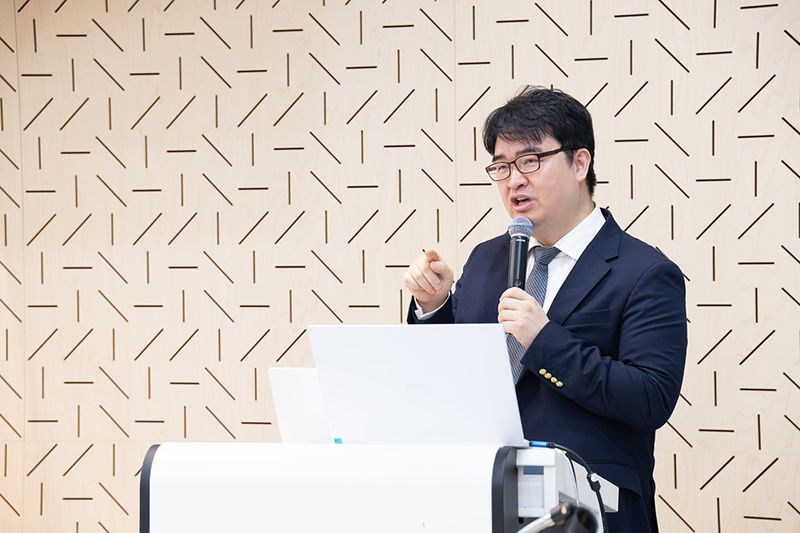
[Financial News] Leading AI scholars and semiconductor company CEOs, all alumni of Korea Aerospace University, gathered at their alma mater and proposed “low-power AI semiconductors” and “world models that discover principles on their own” as next-generation solutions to move beyond the existing AI ecosystem centered on NVIDIA. On the 13th, KAU said that Kim Nok-won, CEO of DEEPX, and Professor Ahn Seong-jin of the School of Computing at the Korea Advanced Institute of Science and Technology (KAIST) presented these strategies for the future AI industry at an AI experts’ seminar held at Vision Hall at KAU in Goyang, Gyeonggi Province, on the 12th.
Kim Nok-won, CEO of DEEPX and a 1997 entrant to KAU’s Department of Aerospace Electronics, spoke first, saying, “An era of ‘physical AI’ is opening, as AI that used to create text and images on screens enters the real world through robots, cars and factory machinery.” He explained that to run AI on battery-powered devices, dedicated neural processing units (NPUs) are essential in place of conventional graphics processing units (GPUs), which consume a lot of power and generate heat. “I’ll turn all our competitors into friends and grow the ecosystem as much as possible,” Kim said, emphasizing, “If we make it, it becomes the new normal.” On building the company’s software platform, he expressed confidence, saying, “We can work with anyone, and we have our own, so we can get it done within two to three years.” Recognized for its technological capabilities, DEEPX is collaborating with Hyundai Motor Group and China’s Baidu, among others, and one of its products was recently selected as a CES 2027 Innovation Award winner.
Professor Ahn Seong-jin, a 2000 entrant to KAU’s computer and information engineering program, who spoke next, identified the “world model”—which enables AI to learn an internal model of how the world works—as a key engine for next-generation AI. Ahn divided the development of world models into three stages: recognizing and representing objects in a scene; predicting the next state; and theorizing underlying principles. He said that technologies currently attracting global attention remain at the second stage.
Ahn explained, “AI must go beyond simple prediction and develop the third-stage ability to theorize—to discover the laws of the world on its own through observation alone and respond to unfamiliar situations—in order to approach true physical AI and human intelligence.” Ahn, who is conducting joint research with Professor Yoshua Bengio, a world-renowned AI scholar, received the Best Paper Award for this research at a workshop at the International Conference on Machine Learning (ICML 2026) in July this year.
The event was held as part of the Ministry of Education’s Innovation Convergence University Project in Advanced Fields and organized by KAU’s Next-Generation Communications Innovation Convergence University Project Group. KAU President Heo Hee-young said, “Given the strong interest from industry and faculty, we will make this seminar a regular colloquium held once or twice a year.”
[email protected] Kim Man-gi Reporter