“My Eyes Were Stinging, So I Went to the Hospital”...‘This Living, Moving Thing’ Found Inside the Eyeball [Alarming Symptoms]
- Input
- 2026-11-13 19:00:00
- Updated
- 2026-11-13 19:06:28
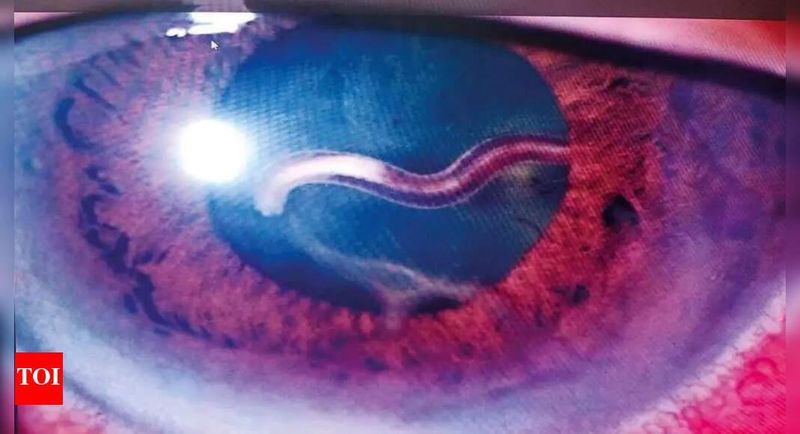
[Financial News] The eyes were stinging and severely bloodshot. The patient also felt bloated. They thought it was a simple eye condition caused by fatigue, but the results of detailed tests were alarming. The retina was bleeding, and the optic nerve was severely swollen.
On the 18th day of battling an infection of unknown cause, a chilling scene was captured through a special lens on an ophthalmic microscope. Something was wriggling right in the middle of the transparent “lens,” which serves as the eye’s camera lens.
On the 12th (local time), U.S. medical news outlet Medical Daily highlighted an extremely rare parasitic infection case reported in the international journal Indian Journal of Ophthalmology by doctors at Aravind Eye Hospital in Chennai, India.
The patient, an adult foreign national, said they had suffered from gastrointestinal problems and eye pain since eating undercooked meat. Doctors initially suspected “endogenous endophthalmitis,” in which a systemic infection spreads to the eye. But on the 18th day after testing and observation began, images from anterior segment optical coherence tomography (AS-OCT)—which uses light to scan cross-sections of the front of the eye—answered all the questions.
A “living parasite” had taken up residence inside the lens at the back of the eyeball.
The lens is a vital tissue that refracts light to form an image on the retina, and it must remain clear, without even a speck of debris. This is the first time in the history of medicine worldwide that a living worm has been seen burrowing into and swimming inside the lens.
The unwelcome intruder was Gnathostoma spinigerum.
It is a parasitic nematode that enters the human body when people eat undercooked meat, such as infected freshwater fish or frogs. It usually crawls beneath the skin and causes pain, but in this patient’s case, the parasite traveled through blood vessels and tissue, burrowing into the eye’s most sensitive part—the lens.
The parasite was removed in highly precise surgery. It was a tense situation: accidentally damaging the lens while extracting the parasite could have led to permanent vision loss. Using advanced ophthalmic surgical techniques, the medical team successfully removed the live Gnathostoma worm intact without touching the lens. The tissue test also clearly confirmed it was Gnathostoma spinigerum.
The researchers warned, “If unexplained eye inflammation or vision loss develops after eating undercooked or raw food, people should not dismiss it as conjunctivitis. They should consider the possibility of a parasitic infection and undergo detailed testing.”
The chilling journey of a tiny worm that entered through the mouth, pierced the skin, and crawled all the way into the eyeball. This harrowing mystery ultimately ended with a small parasite being plucked out with tweezers on the operating table.
[email protected] Jeon Sang-il Reporter