LG Electronics’ Tennessee Battery Plant Surpasses 10 Million Units in Cumulative Production
- Input
- 2026-11-15 10:00:00
- Updated
- 2026-11-15 10:00:02
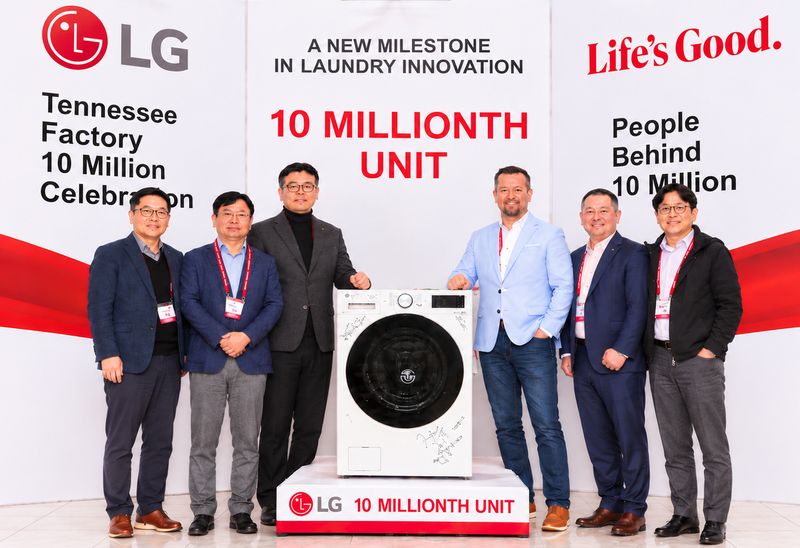
[Financial News] LG Electronics’ Tennessee battery plant has reached cumulative production of 10 million units. The plant is seen as having established itself as a U.S. production and supply hub, with about $500 million invested to date and annual production capacity of 2.25 million units. With the Tennessee battery plant achieving productivity on a world-leading level, LG Electronics plans to step up its efforts to capture the U.S. market.
LG Electronics said on the 15th that it held an event at its Tennessee production subsidiary in Nashville, Tennessee, on the 13th (local time) to mark cumulative production of 10 million units and recognize the efforts and dedication of employees who contributed to the achievement. Attendees included LG Electronics Living Solutions Business head Son Chang-woo, Tennessee production subsidiary head Park Yong, and Wes Golden, mayor of Montgomery County.
LG Electronics secured a 1,254,000-square-meter site in Clarksville, Tennessee—about the size of 175 soccer fields—and built its Tennessee battery plant there. It began producing washing machines in November 2018, expanded its product lineup to include dryers in 2022 and WashTower in 2023, and now produces a total of 2.25 million units a year, including 1.55 million washing machines and 700,000 dryers.
■ Integrating Korea’s innovative technologies with the U.S. production system
The Tennessee plant’s reliable product supply is the result of combining the product development and mass-production know-how of the Changwon plant with the core technologies developed at the Gasan R&D campus, including motors, compressors, energy efficiency and controls.
Since establishing the Tennessee battery plant, LG Electronics has been expanding its presence in the U.S. laundry appliance market.
According to market research firm TraQline, LG Electronics ranked first in the U.S. by sales-based market share for washing machines and dryers. Its shares rose from 17.2% and 17.4%, respectively, in 2018, before the Tennessee battery plant began operations, to 23.3% and 24.1% last year, increases of 5.1 and 6.7 percentage points, respectively.
The Tennessee battery plant’s strengths include the ability to establish a rapid supply chain. Its location in the central and eastern United States makes it possible to quickly transport products to distribution networks across the country. The time it took for products made at overseas sites in Korea, China and Southeast Asia, among other places, to reach local stores—about 10 weeks or more—has been sharply reduced to about one week.
The explanation is that, despite higher labor and infrastructure costs, the plant has also improved cost-effectiveness and supply chain stability.
The Tennessee battery plant reduces ocean freight costs and import tariffs associated with bringing finished products in from overseas. It can also ensure a stable supply of products to the U.S. market when ocean freight rates surge or disruptions affect global logistics networks.
■ Expanding its role in demonstrating physical AI
The Tennessee battery plant is expanding its role as a site for advancing LG Electronics’ cutting-edge manufacturing technologies and demonstrating its physical artificial intelligence (AI) capabilities.
The Tennessee battery plant was the first home appliance factory in the United States—and the first factory built overseas by a Korean company—to be named a Lighthouse Factory by the World Economic Forum (WEF). With about 300 industrial robots deployed in production and logistics and smart factory technologies such as AI and digital twins in use, it has achieved a process automation rate of about 70%, among the highest of LG Electronics’ global production bases.
LG Electronics recently deployed its LG CLOiD robot on a production line at the Tennessee battery plant and is conducting proof-of-concept (PoC) testing in actual manufacturing processes, including carrying washer top panels and aligning and stacking drain pumps. The company plans to advance its physical AI technology by building a virtuous data cycle: work data collected at the site will be augmented and synthesized at the Yangjae Data Factory for robot training, then fed back into the demonstration process.
LG Electronics HS Business Division head and Vice President Seungtae Baek said, “The Tennessee plant has reached cumulative production of 10 million units as LG Electronics’ laundry appliances have continued to earn recognition from customers in North America.” He emphasized, “We will further strengthen our leadership in the North American market with differentiated products and AI-based manufacturing innovation.”
[email protected] Park So-hyun Reporter