Seasonal Fruit Prices Fall One After Another ... A Welcome Break for Year-End Grocery Bills
- Input
- 2026-11-15 12:47:25
- Updated
- 2026-11-15 12:47:25
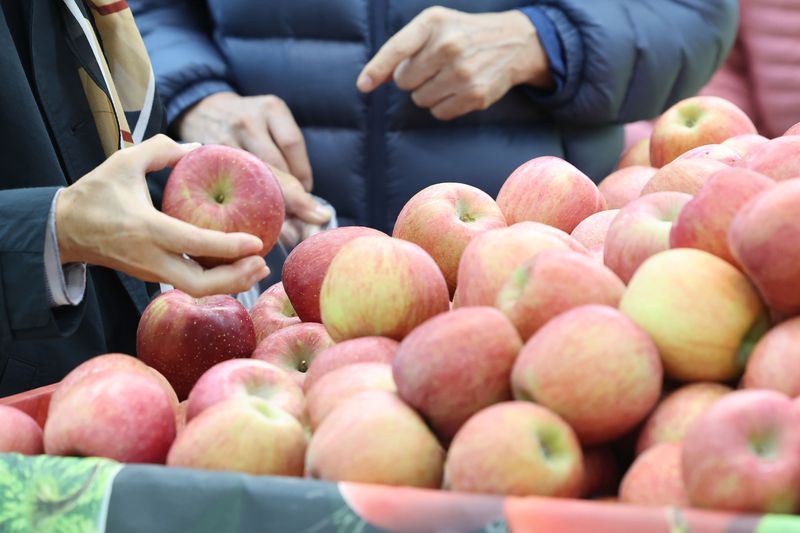
[Financial News] Seasonal fruit prices are falling, bringing welcome relief to grocery bills for the first time in a while. Apple prices, which burdened consumers last year when they were high, have dropped more than 30% in a year as improved growing conditions boosted this year's production. Mandarin orange prices are also declining. With shipments of major winter fruits expected to increase through year-end, the burden of buying fruit is forecast to ease further.
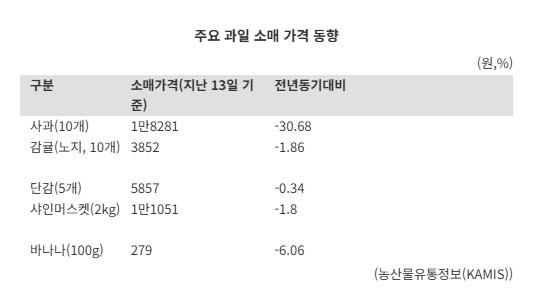
According to Agricultural Products Distribution Information (KAMIS) on the 15th, as of the 13th, the retail price of apples (10) was 18,281 won, down 30.68% from the same period last year. That is also 28.46% lower than the average for a typical year. Apple prices, which were high last year amid lower production and poor growing conditions, are now falling markedly thanks to increased production. The main reason for the decline is improved growing conditions. Weather was generally favorable this year, improving apple growth compared with last year, and production rose as the cultivated area also expanded.
According to the Agricultural Outlook Center of the Korea Rural Economic Institute, this year's apple production is expected to increase 10.8% from the previous year to 496,000 tons. The cultivated area is also projected to grow 5.1% year over year to 34,901 hectares. The volume reaching the market is expected to rise as well. Apple shipments this month are forecast to increase 13.8% from a year earlier. Shipments are also projected to be up 4.2% year over year after December this year, suggesting that price stability driven by expanded supply will continue for the time being.
Mandarin orange prices are also continuing to fall. As of the 13th, the retail price of open-field-grown mandarin oranges (10) was 3,852 won, down 1.86% from the same period last year. The decline is not as steep as for apples, but expectations for price stability are rising as both production and shipments are expected to increase.
This year's mandarin orange production is forecast to increase 5.6% from the previous year to 433,000 tons. Shipments this month are expected to rise 8.1% year over year, and those in December are projected to increase 5.2%. This means supply capacity is expanding ahead of the peak winter fruit consumption season.
As of the same day, the retail price of sweet persimmons (5) was 5,857 won, down 0.34% from the previous year, while Shine Muscat grapes (2 kg) fell 1.8% to 11,051 won.
Bananas, an imported fruit, were priced at 279 won per 100 g, down 6.06%. An official at the Agricultural Outlook Center of the Korea Rural Economic Institute said, "Imports increased 0.8% from the previous year thanks to favorable growing conditions in Vietnam." The official added, "Weather conditions in major producing regions are also favorable this month, so imports are expected to increase."
An industry official said, "The expanded supply, particularly of apples and mandarin oranges, is expected to contribute positively to price stability in the year-end fruit market." The official added, "Increased production resulting from improved growing conditions will lead to actual declines in retail prices that consumers can feel."
[email protected] Kim Seo-yeon Reporter