From Ethics Probe Into Choi Min-hee to Boycott, Kim Min-seok's Leadership Faces a Test Amid Lee's Overseas Trip
- Input
- 2026-11-13 15:40:17
- Updated
- 2026-11-13 15:40:17
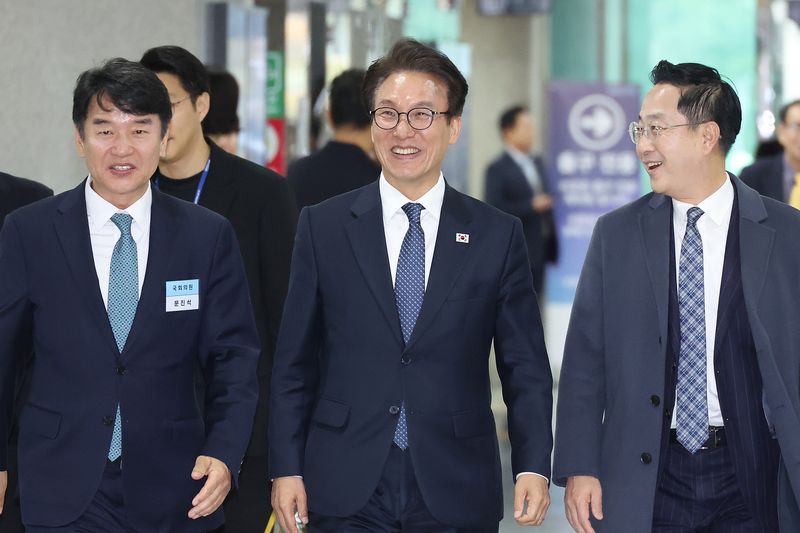
According to political sources on the 13th, factional conflict within the DPK escalated into an all-out battle around that day's Supreme Council meeting. Supreme Council members Choi Min-hee, Lee Seong-yun and Han Min-su, who are considered part of the pro-Jung faction, all skipped the meeting chaired by Kim and held a separate news conference calling for a leadership overhaul. They objected to the order for an ethics probe into Choi, arguing instead that Kim should be investigated. The pro-Lee faction countered by labeling their collective action divisive and even calling for Choi's expulsion.
The conflict began with allegations that Shincheonji Church of Jesus, the Temple of the Tabernacle of the Testimony (Shincheonji) members had joined the party en masse. During the party's investigation, controversy erupted over a targeted probe aimed at former leader Jung Chung-rae. Tensions between the factions then boiled over when Choi's remarks about President Lee came under scrutiny. After Kim launched an ethics probe, the pro-Jung faction mounted a collective protest, and a power struggle over control within the party appeared to take hold in earnest.
A breakthrough through unity across the broader ruling camp also remains elusive. Some within the DPK have revived calls for a merger with the Rebuilding Korea Party, but the latter is keeping its distance and demanding an apology for the previous push to merge. In a poll released that day by Gallup Korea, 38% opposed a merger between the two parties, compared with 26% in favor. President Lee's job approval rating also fell 2 percentage points from the previous week to 39%. The DPK's approval rating rebounded by 3 points to 39%, but concerns are growing that prolonged internal conflict could weigh on the administration's ability to govern.
One factor is that President Lee is set to travel overseas from the 16th to the 19th to attend an ASEAN-related summit in the Philippines and an Asia-Pacific Economic Cooperation (APEC) summit in China. The continued prominence of infighting within the ruling party while the president focuses on summit diplomacy is also a burden for Kim. Rather than escalate public confrontations with the pro-Jung faction, Kim's camp is likely to seek a way through the political impasse by combining efforts to restore discipline in the party leadership through the ethics probe with a policy drive focused on people's livelihoods.
Next week, the DPK will hold a policy caucus meeting to discuss legislation to protect victims of crimes involving personal relationships. The aim is to address gaps in victim protection and offender management in the wake of the recent murder of a minor who was a victim of sexual violence. Attention is also focused on whether the party can offer practical solutions to concerns about victim protection raised during the overhaul of the criminal justice system, including prosecution reform.
The budget bill review subcommittee of the National Assembly's Special Committee on Budget and Accounts, which gets underway in earnest next week, will also provide a stage for the party to showcase policy achievements. The DPK is expected to review the budget with a focus on increasing funding for fire services and reviving the livelihood economy. At a dinner with President Lee on the 11th, Kim had called for bold, swift measures to overcome polarization and boost consumption. While the president focuses on summit diplomacy, the ruling party can underscore a division of labor with the presidential office by focusing on people's livelihoods and legislation.
The key question is whether the policy drive can lead to a recovery of control within the party. Kim's political standing could depend on whether the results of the ethics probe into Choi and any subsequent measures curb the pro-Jung faction's organized resistance or instead intensify factional conflict. The possibility of political backlash cannot be ruled out if the party rushes to take tough measures during the president's overseas trip.
Ultimately, Kim faces the dual task of restoring discipline within the party leadership and, externally, eclipsing factional conflict through achievements on people's livelihoods and legislation. If the president's overseas trip is the first test, the year-end budget and legislative proceedings are likely to be a turning point that will show whether Kim can shore up his shaken leadership.
The opinion poll cited in the article was conducted by Gallup Korea from the 10th to the 12th among 1,002 people aged 18 and older nationwide. The margin of error is ±3.1 percentage points at the 95% confidence level. More details are available on the Central Election Poll Deliberation Commission website.
[email protected] Jiwon Song Reporter