29-Year-Old Bank Employee: “Extra Income Is Irregular... How to Save?” [Personal Finance Q&A]
- Input
- 2026-11-14 08:00:00
- Updated
- 2026-11-14 08:00:03

Q. A, a 29-year-old bank employee in their fifth year, has a stable job and has built up a sizable nest egg, but is unsure how to manage their assets. Because additional income comes in each month on top of their salary, their spending repeatedly rises along with their income in months when they earn more.
Their regular monthly savings currently consist of a Youth Leap Account and a pension savings plan supported by their employer as a welfare benefit. They leave the money left over in a checking account without any particular purpose. Although they bought stocks because they felt investing was necessary, they are unsure whether to invest more money given their limited experience.
A's monthly income totals 3.35 million won, comprising a take-home salary of 3 million won and 350,000 won in pension savings supported by the company. Fixed expenses total 150,000 won, including 130,000 won for insurance premiums and 20,000 won in donations. Variable expenses total 950,000 won, including 600,000 won for personal spending, food and necessities; 40,000 won for telecommunications; 40,000 won for online video services (OTT); 80,000 won for meals at work; 160,000 won in membership dues; and 30,000 won for exercise.
Each month, A saves a total of 1.05 million won: 700,000 won in a Youth Leap Account and 350,000 won in pension savings. The remaining 1.2 million won goes into a checking account. A's assets total 126 million won: 62 million won in a checking account, 10 million won in a housing subscription savings account, 18 million won in a Youth Leap Account, 25 million won in stocks and 11 million won in pension savings. Annual irregular expenses amount to 12 million won, while additional income beyond salary is about 10 million won a year.
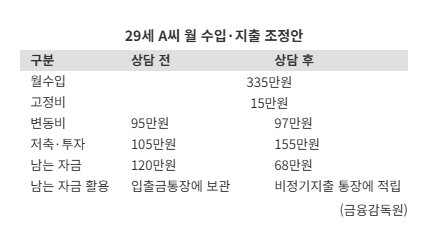
A. According to the Financial Supervisory Service (FSS), A has built up a sizable nest egg thanks to a stable job and income, but lacks a clear spending plan and savings goals. Because the irregular additional income is not managed separately, spending also rises when income increases. Before choosing additional financial products, the priority is to set a spending budget and savings goals for each stage of life.
Monthly spending should be managed at around 1.12 million won in total fixed and variable expenses. The approach is to set budgets for individual categories, including 600,000 won for personal spending, dining out and necessities, and 100,000 won for meals at work, and to control spending by using a debit card rather than a credit card.
Annual irregular expenses should be reduced from 12 million won to around 8 million won. About 680,000 won should be set aside each month in a dedicated account for irregular expenses, to cover family and friends' celebrations and condolence gifts, travel, clothing and grooming. The proposal is to use the salary account for automatic payments such as insurance premiums and savings, while keeping separate accounts for living expenses and irregular expenses—a strategy known as “splitting accounts.”
As A may need the money for a wedding within three years, short-term funds should be kept in deposits and installment savings accounts, which carry a low risk of principal fluctuation. Additional income beyond salary should go into a flexible installment savings account and be moved into a time deposit when it matures. Another proposal is to leave 7 million won of the 62 million won in the checking account as an emergency fund and move the rest into a time deposit.
Monthly savings should increase from the current 1.05 million won to 1.55 million won. The plan is to maintain the 700,000 won contribution to the Youth Leap Account and the 350,000 won in pension savings, while allocating 500,000 won a month to regular investments through an Individual Savings Account (ISA).
Funds should be divided according to their intended use and when they will be needed. The Youth Leap Account, the installment savings funded by additional income and the time deposit transferred from the checking account will be used for wedding expenses. Regular investments through the ISA will go toward a home purchase after the wedding. The employer-supported pension savings should be maintained over the long term for retirement.
Funds needed in two to five years should be accumulated mainly through deposits and installment savings, while funds that can be invested for five years or longer can seek returns through regular investments. However, rather than raising the investment share too aggressively, A should gain investment experience while maintaining sufficient liquid funds. It is also important to set a target return and manage the funds in line with when they will be needed.
If A saves 1.55 million won a month and adds about 10 million won in additional income each year, A can save about 28.6 million won a year. The goal is to build up about 87 million won for wedding expenses over three years.
The FSS advised reviewing monthly expenses every month and checking quarterly or semiannually whether irregular expenses stayed within budget. A should also review progress toward the annual savings goal, increase savings when wages rise or additional income comes in, and readjust the shares allocated to savings, investments and retirement funds whenever a financial goal, such as getting married or buying a home, is achieved.
Consumers can receive free, personalized financial counseling by searching for the FSS-operated financial consumer portal, FINE, online, or by calling the FSS call center at 1332 (▶7 for Financial Advisory Services).
[email protected] Lee Jeong-hwa Reporter