“Color TV Has Finally Arrived in Sejong City” ... 300 People Flock to Sejong McDonald’s in an Opening-Day Frenzy Amid Self-Deprecating Mockery
- Input
- 2026-11-13 16:01:26
- Updated
- 2026-11-13 16:01:26
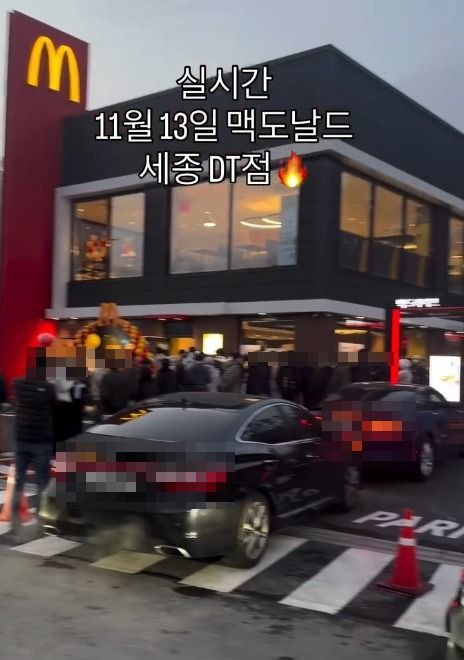
[Financial News] The area around the McDonald’s Sejong DT branch, which opened at 7 a.m. on the 13th in Bonan-ri, Janggun-myeon, Sejong Special Self-Governing City, was severely congested by crowds and vehicles that began gathering before dawn. College students started lining up at 2 a.m., five hours before opening, and by 7 a.m. sharp, around 300 people were waiting. The 24-space parking lot was full early, and the tumblers and mugs offered as gifts to the first 150 customers on a first-come, first-served basis were gone within five minutes of opening. As the line showed no sign of getting shorter, there was even the unusual sight of office workers giving up on hamburgers and heading to nearby gukbap restaurants instead.
Online communities are filling with self-deprecating jokes and mocking posts about the opening-day rush, with comments such as “Color television has finally arrived in Sejong City” and “Now it’s finally become a real city.” The opening of a simple fast-food restaurant may be all it is, but behind it lie Sejong’s distorted commercial-district structure and shortage of commercial and cultural infrastructure, as the administrative capital marks its 14th year since launch.
Sejong, a blind spot for the “Big Mac Index” ... an explosion of pent-up consumer sentiment
Until now, Sejong City was the only one of the country’s 17 metropolitan local governments without a McDonald’s restaurant. Although central government agencies moved there in large numbers and young civil servants and families moved in, not even a major global franchise had managed to open a store. Residents had to make what came to be called “Big Mac pilgrimages” to Daejeon or Cheongju.
The retail industry sees the opening-day rush as “revenge spending driven by a lack of infrastructure.” One retail industry insider explained, “McDonald’s, an everyday consumer good in other regions, seems to have been seen by Sejong residents as a kind of ‘symbol of urban infrastructure.’ It shows just how intense the thirst for commercial and cultural facilities in the area had become, to the point that a college student who had queued since 2 a.m. said they ‘felt proud.’”
Why the “outskirts of Janggun-myeon” and not downtown? The paradox of rents and regulations
What stands out is the location of Sejong City’s first store. The Sejong DT branch is in Bonan-ri, Janggun-myeon, an outlying area that cannot be reached on foot from Government Complex Sejong or the main residential complexes in the urban neighborhoods. Civil servants at the complex have to travel by car to visit during their lunch break.
The biggest obstacles McDonald’s Korea has faced in opening a store in Sejong City have been high rents and strict urban planning regulations. Despite vacancy rates in Sejong City’s central commercial districts reaching some of the highest levels in the country due to high sale prices and rents, it has been difficult to meet the large-space and long-term lease requirements of major franchises.
Drive-through (DT) restaurants, in particular, require access points for vehicles to enter and exit from the roadside. But strict building and traffic regulations in downtown Sejong, a planned city, became a barrier to entry. McDonald’s ultimately chose a workaround: instead of entering the downtown area, it opted for a roadside location on the outskirts, where regulations are relatively less restrictive and car access is easier.
Region-specific “localization” and the food-service industry’s expansion strategy
With the opening of the Sejong DT branch, McDonald’s Korea introduced a thoroughly region-specific localization strategy. The two-story building, with a floor area of about 502 square meters (152 pyeong), was designed as a “family-friendly store,” reflecting the demographics of Sejong City, often considered the country’s youngest city, where households of civil servants and office workers in their 30s and 40s with young children are concentrated.
The most notable feature is the blending of spaces to create a “cultural space for extended stays” that goes beyond somewhere to simply eat. A book café created in collaboration with Youngpoong Bookstore was installed on the second floor, and the children’s bookshelf, inspired by Irworobongdo, a Joseon-era royal screen painting, was stocked with books suited to readers from preschool age through the upper elementary-school grades. The plan is to keep changing the books to suit the seasons and readers’ ages, encouraging families to stay longer. In addition, before the official opening, on the 11th, the store invited around 50 children from two nearby community child centers for a book-café experience and a magic show. It also provided “Burgers of Happiness,” including McChicken and other items, and donated books. Through this locally focused ESG marketing, it further expanded its engagement with the community. The move is part of McDonald’s Korea’s expansion strategy, which aims to grow its nationwide store count to 500 by 2030. Securing a symbolic first store in an untapped regional hub is seen as a way to gain both brand buzz and tangible profitability.
[email protected] Moon Young-jin Reporter