To Check the Public Prosecution Office's Indictment Powers... 'The CIO's Prosecution Scope Should Be Expanded'
- Input
- 2026-11-13 15:12:26
- Updated
- 2026-11-13 15:12:26
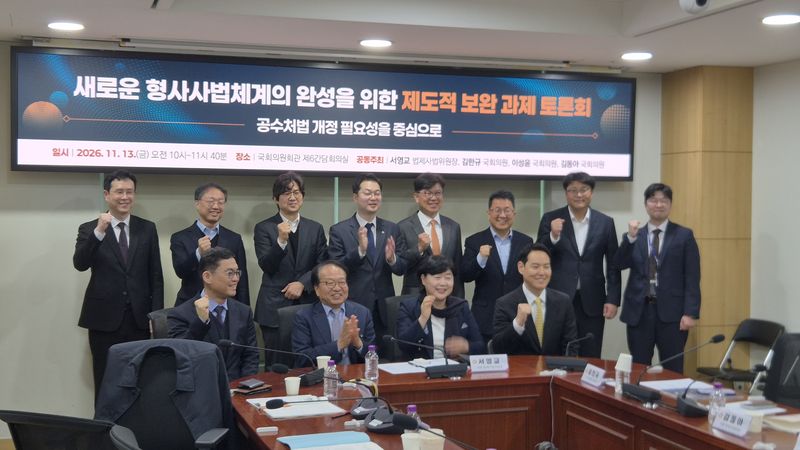
[Financial News] Amid a restructuring of the criminal justice system following the abolition of the Prosecution Service (PS) and the launch of the Public Prosecution Office, legal experts have called for expanding the indictment powers of the Corruption Investigation Office for High-ranking Officials (CIO). The aim is to distribute the power to indict, which is concentrated in the Public Prosecution Office, strengthen checks and balances among agencies, and address the structural problem of a mismatch between the CIO's investigative and prosecutorial jurisdictions.
At a forum on institutional measures to complete the new criminal justice system, held at the National Assembly on the 13th, Oh Byung-doo, a professor at Hongik University's College of Law, argued that the CIO should be developed as an institutional mechanism for diversifying prosecutorial authority. He said there was still a shortage of permanent agencies able to replace or check the Public Prosecution Office's power to indict. He noted, “The 2026 revision of the Criminal Procedure Act achieved a considerable degree of diversification in investigative authority,” but added, “I question whether prosecutorial authority is being diversified.”
Professor Oh noted that if the CIO were converted into a purely investigative agency, the Public Prosecution Office's monopoly on the power to indict could be strengthened. He therefore proposed establishing the CIO as a prosecutorial body on an equal footing with the Public Prosecution Office and creating “cross-jurisdiction” arrangements that would allow the two agencies to check each other. In particular, he proposed allowing the CIO chief to bring charges directly through an application for adjudication if the Public Prosecution Office declined to prosecute a case investigated by the CIO.
Yun Dong-ho, a professor at Kookmin University's College of Law, also stressed that the CIO's investigative and prosecutorial powers should be aligned. Under current law, the CIO can investigate high-ranking public officials generally, but it can directly indict only a limited group, including judges and prosecutors, police officers at the rank of superintendent general or higher, the head of the Serious Crimes Investigation Agency, and investigators at grade 3 or above.
Professor Yun proposed that the CIO be allowed to indict prosecutors for ordinary crimes as well as corruption, to prevent the Public Prosecution Office from “protecting its own.” The aim, he said, is for the CIO to serve as an effective permanent special prosecutor, replacing special prosecutors appointed depending on the political situation.
Professor Yun explained, “In cases involving crimes by high-ranking public officials, their right to mount a defense is so strong that a powerful body with investigative and prosecutorial powers is needed to respond. In that respect, the CIO is justified as an exception to the separation of investigation and prosecution.”
The CIO also called for expanding its power to indict and clarifying the provisions on related crimes. In a presentation, Park Sang-hyun, the CIO's director of investigation planning, noted, “There is disagreement over whether offenses subject to indictment include related crimes committed by third parties, rather than by the high-ranking official themselves or their family members,” and added, “If the wording of the provision is unclear enough that even courts reach different conclusions, it must be clarified through legislation.”
In particular, in bribery cases, even when the CIO investigates both a high-ranking public official who received a bribe and the private citizen who paid it, its authority to indict the bribe-giver remains unclear. In an actual bribery case involving a police officer at the rank of superintendent general, the court of first instance recognized the authority to indict the bribe-giver, but the appellate court rejected it and dismissed the indictment. Director Park argued that the law should explicitly authorize the CIO to indict third parties for related crimes as well.
It was also emphasized that the figures look different when cases in which the CIO requested prosecution are included in addition to the eight cases it indicted. As of the 10th, the CIO had indicted eight cases and asked the Public Prosecution Office to bring charges in a total of eight cases. Another eight cases involved referrals after investigation with a request for prosecution, requests for an investigation, requests for disciplinary action, or similar measures.
Calls were also made to improve the organization's structure and staffing. CIO prosecutors serve three-year terms and may be reappointed up to three times, while investigators are also appointed to fixed six-year terms. Participants stressed that fixed terms should be abolished and staffing expanded to ensure continuity and expertise in investigations.
At the forum that day, Seo Young-kyo, chair of the National Assembly's Legislation and Judiciary Committee, said, “The people the CIO deals with are senior prosecutors, judges, and police officers, so they are also highly capable of responding.” She added, “I will work through legislation to increase staffing and improve various other conditions.”
[email protected] Choi Eun-sol Reporter