Korea No. 1 Worldwide in Stretchable Display Patents for 10 Consecutive Years
- Input
- 2026-11-15 12:00:00
- Updated
- 2026-11-15 12:00:05
The Ministry of Intellectual Property said on the 15th that it had published the November issue of “Global Technology Trends and Patents in National Strategic Technologies,” which analyzes the latest policy, technology and patent trends in the five major IP jurisdictions (IP5)—Korea, the United States, China, Japan and Europe. The report was prepared to help researchers in the R&D field understand global patent trends and pursue strategic technology planning.
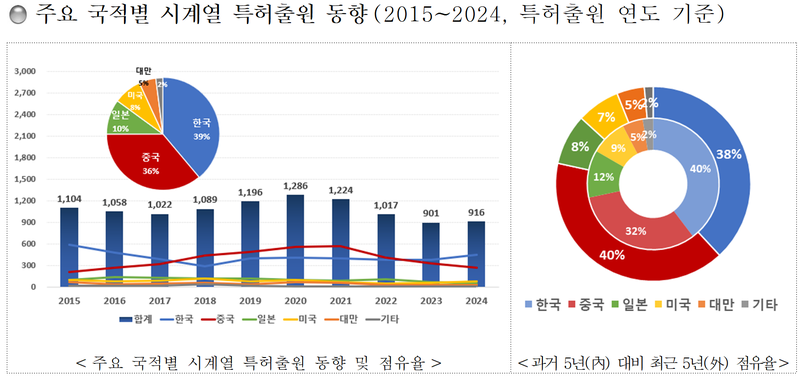
According to the report, South Korea ranked first worldwide in filings in “high-resolution stretchable displays,” a field considered essential to next-generation smartphones and wearable devices because the displays retain clear image quality even when stretched or bent. From 2015 to 2024, the country filed a total of 4,207 applications, outpacing China (3,901), Japan (1,089) and the United States (876). In particular, overseas filings—applications filed outside the applicant’s home country—accounted for 69.5% of the total. South Korea was well ahead of the United States (67.6%) and Japan (66.8%), as well as China (17.1%), whose filings are focused mainly on its domestic market, making it the most active in securing exclusive rights in global markets.
South Korean companies were even more prominent in the rankings of top patent filers. Samsung Display filed 2,070 applications, more than twice the 1,023 filed by second-place China-based BOE, securing a commanding lead worldwide. Samsung Display alone filed more applications than Japan and the United States combined. LG Display (851, third) and Samsung Electronics (597, fifth) also made the global top five, giving South Korea three companies on the list. Their combined 3,518 filings accounted for 32.5% of related patents worldwide.
South Korea also made significant strides in “AI model compression and inference optimization,” which reduces AI models’ size and computational load to produce results quickly with less power. Patent filings in this field, which is key to on-device AI and reducing data-center operating costs, surged about 85-fold in 10 years, from 9 in 2015 to 762 in 2024. South Korea ranked third worldwide with 396 filings, behind China (1,123) and the United States (870). Among companies with the most filings, Google ranked first with 151, while Samsung Electronics took second place worldwide with 146, just five filings behind. They were followed by Intel (102), Microsoft (95) and Qualcomm (84). Other active filers include the Korea Advanced Institute of Science and Technology (KAIST; 23), the Electronics and Telecommunications Research Institute (ETRI; 22), and South Korean AI semiconductor and software startups DEEPX (16) and FriendliAI (16), which are also actively seeking to secure intellectual property rights.
The government is stepping up efforts to link patent analysis with R&D. In September, the Ministry of Intellectual Property approved the “IP-Based R&D-IP-Commercialization Innovation Support Plan” at the Ministerial Meeting on Science and Technology. The plan calls for embedding intellectual property strategies from the R&D stage, securing key overseas patents and standard patents, and building a public-sector IP commercialization ecosystem. The ministry also plans to reflect patent trends and analyses of promising technologies in strategic technology fields in the direction of R&D, and to gradually expand the development of sector-specific patent strategy maps, including for physical AI.
Kim Il-gyu, director of the Ministry of Intellectual Property’s Intellectual Property Policy Bureau, said, “We will provide high-quality patent analysis information to the R&D field in a timely manner so that we can maintain a decisive lead in areas where we have strengths, such as high-resolution stretchable displays, and secure leading competitiveness early in future core fields such as AI model compression.”
The November issue also covers trends in a total of six national strategic technology fields, including drive components for high-performance humanoids; communications satellite payloads and buses; AI-based security threat detection and analysis; and power semiconductor device design and processes. It is available to read free of charge on the Ministry of Intellectual Property’s website.
[email protected] Kim Won-jun Reporter