President Lee's 'Blitzkrieg' Call Prompts Ruling Party to Review Mega-Project Budget Proposal
- Input
- 2026-11-13 14:48:26
- Updated
- 2026-11-13 14:48:26
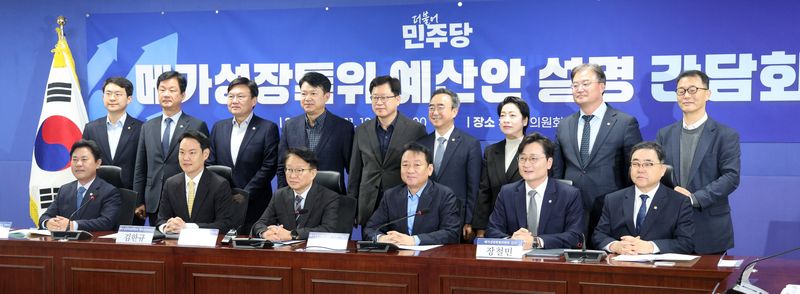
The DPK's Mega Growth Special Committee held a briefing on budget proposals related to mega-projects at the National Assembly that day and discussed how to respond during the budget review process.
“Our Republic of Korea needs a new innovative economy and growth, and a key means of achieving that is to create a new economy through super-regional special zones,” said Lee Kwang-jae, the committee's senior vice chair. “I will work to ensure that the law is passed within this year and that the budget is approved within the year, so we can set in motion the two wheels of law and budget and move toward a new innovative economy.”
“A thorough, well-structured budget is the starting point for growth for all and for everyone to share its benefits,” emphasized Kwon Chil-seung, the committee's standing vice chair.
“I believe the outcome of this committee is important enough to determine the success or failure of the Lee Jae Myung administration,” Kwon said. “There will be various debates and controversies over the Super-Regional Special Zone Act by the end of the year. I hope our committee will navigate these issues wisely and take the lead in building ‘Growth for All, an Irreplaceable Korea.’”
All ministries involved in the mega-projects attended the briefing, including the Ministry of Planning and Budget, the lead ministry for the government's budget proposal, as well as the Ministry of Trade and Industry, the Ministry of Science and ICT, the Ministry of Climate and Energy, the Ministry of Land, Infrastructure and Transport, and the Ministry of National Defense. The ministries are reported to have briefed the party on mega-project-related programs included in next year's budget proposal and requested its cooperation.
Jang Chul-min, secretary of the Mega Growth Special Committee, told reporters after a closed-door meeting, “We discussed the issues the government is focusing on and the areas the DPK needs to push forward further.”
Jang said the discussion focused in particular on infrastructure budget proposals to address power and water needs at artificial intelligence (AI) data centers. “I estimate that 80 trillion won will be needed for power over the next 10 years, and that about 50 trillion won will need to come from the national treasury,” he said, adding, “There were views on the Ministry of Climate and Energy's plans to address power issues whose uncertainties vary by region.”
More specifically, the government reportedly told the party it estimates that 79 trillion won will be invested in expanding power infrastructure for the country's advanced industries and around 5 trillion won in expanding water infrastructure by 2036. Of this, state funding is expected to total 58 trillion won.
However, Jang said the labor exceptions in the Super-Regional Special Zone Act, the biggest point of contention, were not discussed that day. With differences of opinion over the labor exceptions among the business community, labor groups and even within the DPK, a full-fledged review of the bill has yet to begin. Jang added, “We will proceed with discussions on contentious issues by scheduling separate meetings of the Policy Committee and the party's policy caucus.”
[email protected] Kim Hyeong-gu Reporter