Students From Seoul Make Up 5.8% of Entrants at Regional Flagship National Universities, Down From Five Years Ago
- Input
- 2026-11-13 14:06:11
- Updated
- 2026-11-13 14:06:11
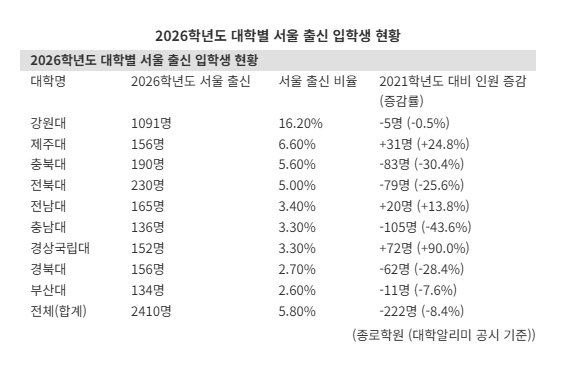
[Financial News] In the 2026 academic year, students from Seoul accounted for 5.8% of entrants at the country's nine regional flagship national universities. Although the number of entrants increased from the previous year, their share of all new entrants has remained in the upper 5% range since the 2022 academic year.
According to an analysis of disclosure data from the University Information Disclosure System by Jongro Academy on the 13th, 2,410 students from Seoul entered the nine regional flagship national universities in the 2026 academic year, accounting for 5.8% of the total 41,457 entrants. The number of entrants from Seoul rose by 130, or 5.7%, from 2,280 in the previous academic year, 2025, while their share remained unchanged at 5.8%.
By year, the figure was highest in the 2021 academic year, when data on entrants by region were first released, at 2,632 students, or 7.4%. It then stood at 2,153, or 5.8%, in 2022; 2,154, or 5.8%, in 2023; 2,232, or 5.9%, in 2024; 2,280, or 5.8%, in 2025; and 2,410, or 5.8%, in 2026, remaining between 5.8% and 5.9% for five consecutive years. Compared with the 2021 academic year, five years earlier, the number of entrants from Seoul fell by 222, or 8.4%, and their share declined by 1.6 percentage points.
By university, eight of the nine had a share of students from Seoul in the 6% range or lower. Kangwon National University, at 16.2%, was the only one above 10%. It was followed by Jeju National University at 6.6%, Chungbuk National University at 5.6%, Jeonbuk National University at 5.0%, Chonnam National University at 3.4%, Chungnam National University and Gyeongsang National University at 3.3% each, Kyungpook National University at 2.7%, and Pusan National University at 2.6%. Kangwon National University had 1,091 entrants from Seoul in the 2026 academic year, up 121 from 970 the previous year, but their share fell from 19.5% to 16.2%.
Compared with the 2021 academic year, the universities that had more entrants from Seoul were Gyeongsang National University, Jeju National University and Chonnam National University. Gyeongsang National University rose from 80 to 152, an increase of 72, or 90.0%, nearly doubling. Jeju National University increased by 31, or 24.8%, from 125 to 156, while Chonnam National University was up by 20, or 13.8%, from 145 to 165. By contrast, Chungnam National University fell by 105, or 43.6%, from 241 to 136. The other six universities also had fewer entrants from Seoul than five years earlier: the declines were 30.4% at Chungbuk National University, 28.4% at Kyungpook National University, 25.6% at Jeonbuk National University, 7.6% at Pusan National University and 0.5% at Kangwon National University.
Jongro Academy said that, among universities outside Seoul, Yonsei University Mirae Campus, at 27.2%, and Korea University Sejong Campus, at 22.9%, had the highest shares of students from Seoul in the 2026 academic year.
Lim Seong Ho, head of Jongro Academy, predicted, "The movement of top-performing students from the Seoul area to regional flagship national universities may not be substantial." Lim said, "Location is also a factor in students from Seoul deciding whether to attend a regional flagship national university, but the scores that make them eligible to apply appear to play a significant role." He inferred that at universities with high admission cutoffs, students from Seoul would have preferred universities located in the Seoul area.
Lim said, "If top-performing students from Seoul are admitted to both Seoul-area universities and regional flagship national universities through early and regular admissions, the key question appears to be which they ultimately choose." He added, "Even at universities outside Seoul, we are not seeing much change in applicants' preferences beyond top-tier university brands and specialized fields such as medicine and health sciences."
He also offered an outlook for 2027 college admissions. Lim predicted, "Policies such as zero tuition and the initiative to build 10 universities modeled on Seoul National University could somewhat increase the share of students from Seoul." However, he said, "Based on current trends, there may not be a major shift, and the number of universities where the share exceeds 10% may not increase significantly." He expected that if policy changes and efforts concerning regional flagship national universities continue, some universities could begin to see changes from the 2027 academic year.
[email protected] Kim Man-gi Reporter